Why Strength Training Matters During Weight Loss
Weight loss can reduce both fat and lean tissue. Learn how resistance training can help preserve muscle, improve strength and function, and support healthier body composition during weight loss, including GLP-1 treatment.
Table of Contents
- What Is Strength Training?
- Resistance Training and Strength Training: Are They the Same Thing?
- Weight Loss Can Include Lean Tissue
- Resistance Training Changes the Quality of Weight Loss
- Strength Training May Not Make the Scale Drop Faster
- Muscle Has to Be Given a Reason to Stay
- Protein and Strength Training Work Together
- Why This Matters During GLP-1 Treatment
- GLP-1 Medications Do Not Uniquely "Destroy Muscle"
- Strength Is Different From Muscle Size
- Resistance Training Becomes More Important With Age
- You Do Not Need a Gym
- At home
- At a gym
- During everyday activities
- What Muscle Groups Should Be Trained?
- How Often Should Adults Strength Train?
- How Many Repetitions?
- You Do Not Need to Train to Exhaustion Every Day
- Start Where You Are
- What Does "Progressive" Mean?
- Strength Training and Walking Are Not the Same Thing
- Can Cardio Replace Resistance Training?
- You Cannot "Out-Protein" Complete Inactivity
- The Scale Can Be Misleading When You Start Training
- Muscle Preservation Is Not Just About Appearance
- What About Bone?
- Is Strength Training Safe for Everyone?
- What If Someone Has Never Exercised Before?
- Lower body
- Upper body
- Core and stability
- What If GLP-1 Side Effects Make Exercise Difficult?
- Resistance Training Is Not a Punishment for Eating
- A Simple Strength-Training Checklist
- Watch Function, Not Just Pounds
- Strength Training and Medical Treatment Have Different Roles
- What Happens After Starting Treatment?
- The Goal Is Better Weight Loss — Not Just More Weight Loss
- The Bottom Line
- Explore Participating Provider Options
Why Strength Training Matters During Weight Loss
When people try to lose weight, they often focus on one number:
the scale.
But the scale cannot tell you what kind of weight you are losing.
Weight loss can include:
- body fat
- water
- glycogen
- lean tissue
That is why healthier weight loss is not only about becoming lighter.
It is also about protecting:
muscle
strength
physical function
and
the ability to stay active.
Resistance training — often called strength training — can play an important role.
This may deserve particular attention during GLP-1-related treatment because substantial reductions in appetite and body weight can occur.
Exercise information reviewed September 2026.
Educational information only. Exercise needs should be individualized based on health status, medications, mobility, fitness level, injuries, and other medical considerations. GoLean Horizon does not provide individualized exercise or medical advice.
What Is Strength Training?
Strength training is physical activity that makes your muscles work against resistance.
Examples include:
- free weights
- weight machines
- resistance bands
- body-weight exercises
- certain forms of functional training
- some yoga movements
- carrying or lifting appropriately challenging objects
You do not have to become a bodybuilder.
The goal is simply to challenge muscles enough that they have a reason to adapt.
The U.S. Physical Activity Guidelines recommend muscle-strengthening activity involving the major muscle groups on at least 2 days each week for adults.
Resistance Training and Strength Training: Are They the Same Thing?
The terms are often used interchangeably.
Resistance training describes exercise in which muscles work against some form of resistance.
That resistance might come from:
- dumbbells
- machines
- bands
- gravity
- your own body weight
Strength training generally refers to using this type of exercise to improve or maintain strength.
For this article, the terms refer to essentially the same category of activity.
Weight Loss Can Include Lean Tissue
One reason resistance training matters is that losing weight does not mean losing only fat.
Research involving diet-induced weight loss shows that some fat-free mass can be lost as body weight decreases.
The same concern has received increased attention with GLP-1-related medications because these treatments can produce substantial weight reduction.
A 2026 systematic review comparing incretin therapies and lifestyle interventions found that lean mass accounted for a meaningful portion of total weight lost across both medication and lifestyle approaches.
Importantly, lean mass is not exactly the same thing as skeletal muscle.
It also includes other non-fat tissues and body water.
Still, preserving muscle and physical function during significant weight reduction is an important goal.
Resistance Training Changes the Quality of Weight Loss
This is one of the most important concepts in this entire series.
Two people may each lose:
20 pounds
but those 20 pounds may not represent the same body-composition change.
A recent systematic review and meta-analysis examined resistance exercise during diet-induced weight loss in adults with overweight or obesity.
Adding resistance exercise did not significantly change the amount of total body weight lost compared with diet alone.
But it did:
- protect against loss of fat-free mass
- increase fat-mass loss
- improve muscular strength
That means the scale may look similar while the composition of the weight loss is different.
This is why scale weight alone is an incomplete measure of progress.
Strength Training May Not Make the Scale Drop Faster
This can surprise people.
Someone may start resistance training and expect:
"I'll lose weight much faster."
That is not necessarily what the evidence shows.
Resistance training can improve body composition without dramatically changing the total number on the scale.
The recent meta-analysis found no meaningful additional reduction in total body weight from resistance exercise during dietary weight loss.
But body composition improved.
That is not failure.
It may represent higher-quality weight loss:
more fat loss while preserving more fat-free tissue.
Muscle Has to Be Given a Reason to Stay
Muscle is metabolically costly tissue.
During substantial calorie restriction and weight loss, the body adapts to having less energy available.
Resistance exercise sends a physical signal:
these muscles are still needed.
When a muscle repeatedly works against adequate resistance, the body responds by adapting to that demand.
This can help maintain or improve:
- muscular strength
- muscle function
- lean tissue
during a period when body mass is decreasing.
Protein and Strength Training Work Together
Article #17 explained why protein matters during weight loss.
But protein by itself is not the whole strategy.
Protein provides:
amino acids — the building materials.
Resistance training provides:
mechanical stimulus — the signal.
Current expert guidance on GLP-1 treatment emphasizes combining appropriate protein intake with resistance training to help preserve muscle.
The 2025 joint advisory from major nutrition, lifestyle medicine, obesity medicine, and obesity organizations specifically identifies resistance training as an important strategy for preserving muscle and bone mass during GLP-1 treatment.
Read:
Why Protein Matters During Weight Loss
Why This Matters During GLP-1 Treatment
GLP-1-related medications can reduce:
- hunger
- food intake
- portion size
and can produce substantial weight loss.
Those effects can be clinically valuable.
But large reductions in calorie intake also create conditions in which lean tissue may decline along with body fat.
Current expert guidance therefore increasingly focuses not simply on:
How much weight did the person lose?
but:
What happened to muscle, strength, nutrition, and function while the weight was lost?
That is an important shift.
GLP-1 Medications Do Not Uniquely "Destroy Muscle"
This distinction matters.
A 2026 meta-analysis found that the proportion of weight lost as lean mass during incretin-based treatment was broadly comparable with lifestyle-induced weight loss.
It also found that lifestyle programs incorporating resistance training showed a more favorable lean-mass profile.
So the useful conclusion is not:
"GLP-1 medications destroy muscle."
It is:
"Significant weight loss can include lean-tissue loss, and resistance training is one of the most important tools available to help preserve muscle."
For more on this misconception, read:
GLP-1 Myths: What the Evidence Actually Says
Strength Is Different From Muscle Size
Muscle mass matters.
But so does what your muscles can actually do.
Strength can affect your ability to:
- rise from a chair
- climb stairs
- carry groceries
- lift objects
- maintain balance
- perform household tasks
- remain physically independent
A person can lose weight while becoming physically weaker.
That is not the outcome most people are trying to achieve.
This is why healthy progress should include function — not just body size.
Resistance Training Becomes More Important With Age
Muscle mass and strength naturally tend to decline with aging.
Older adults can therefore be particularly vulnerable when significant weight loss occurs on top of age-related changes.
Loss of muscle and physical function can contribute to:
- weakness
- reduced mobility
- falls
- loss of independence
- sarcopenia
Resistance exercise is therefore especially important to consider in older adults undergoing intentional weight reduction.The program should still be appropriate to the person's fitness, mobility, balance, health conditions, and medical limitations.
You Do Not Need a Gym
Resistance training can happen in many settings.
At home
Examples may include:
- chair stands
- wall push-ups
- resistance bands
- body-weight squats where appropriate
- step-ups
- light dumbbells
At a gym
Options might include:
- weight machines
- free weights
- cable systems
- supervised strength classes
During everyday activities
Some physically demanding activities can also strengthen muscles.
The resistance matters more than whether the exercise happens in an expensive gym.
What Muscle Groups Should Be Trained?
U.S. physical-activity guidance recommends strengthening all major muscle groups.
These include:
- legs
- hips
- back
- abdomen
- chest
- shoulders
- arms
A balanced program therefore includes more than:
biceps curls
or
leg exercises alone.
Whole-body strength supports everyday function.
How Often Should Adults Strength Train?
Current U.S. guidelines recommend muscle-strengthening activities on at least:
2 days per week
for adults.
That does not mean every person should begin immediately with an intense two-day program.
Someone who has been inactive may need to start gradually.
The Physical Activity Guidelines specifically encourage gradual progression in:
- frequency
- intensity
- workload
rather than trying to do too much too soon.
How Many Repetitions?
For general adult physical-activity guidance, CDC describes exercises performed to the point where completing another repetition becomes difficult without assistance.
A commonly referenced range is:
8–12 repetitions per activity
with at least one set, while two or three sets may provide additional benefit.
But that is general guidance — not a personalized exercise prescription.
Someone's appropriate resistance, repetitions, sets, and progression depend on factors including:
- age
- training experience
- injuries
- medical history
- goals
- mobility
- cardiovascular status
You Do Not Need to Train to Exhaustion Every Day
More exercise is not automatically better.
Muscles need:
- stimulus
- adequate nutrition
- recovery
Progressive resistance training generally means increasing challenge gradually as strength and ability improve.
It does not mean:
lifting the heaviest possible weight every session.
Consistency matters more than turning every workout into a maximum-effort test.
Start Where You Are
For someone completely new to strength training, an appropriate starting point might be very different from the routine of someone who has trained for ten years.
Explore My Options
Compare provider options based on factors such as cost, flexibility, support, medication preferences, and overall experience.
Explore My OptionsGoLean Horizon provides educational information and provider-matching resources. A licensed healthcare provider determines whether treatment is medically appropriate.
Progress may begin with:
- standing up repeatedly from a chair
- wall push-ups
- light resistance bands
- controlled body-weight movements
- supervised machines
- light weights
The starting level is less important than developing a safe pattern that can gradually progress.
What Does "Progressive" Mean?
Muscles adapt.
If the exercise always remains extremely easy, there may eventually be little stimulus for further adaptation.
Progressive resistance training means gradually adjusting factors such as:
- resistance
- repetitions
- sets
- exercise difficulty
- range of motion
as appropriate.
The goal is not rapid progression.
It is enough challenge to continue stimulating the muscles while maintaining safe technique.
Strength Training and Walking Are Not the Same Thing
Walking is excellent physical activity.
It supports:
- cardiovascular fitness
- mobility
- energy expenditure
- general health
But ordinary walking does not provide the same muscular stimulus as structured resistance exercise.
Ideally, these activities can complement one another.
For most adults, public-health guidance includes both:
aerobic activity
and
muscle-strengthening activity.
It is not an either/or decision.
Can Cardio Replace Resistance Training?
Not completely.
Aerobic exercise provides major health benefits and can contribute to:
- cardiovascular fitness
- fat loss
- endurance
- metabolic health
But resistance exercise is particularly useful for:
- muscular strength
- lean-mass preservation
- muscular fitness
during weight loss.
A well-rounded activity plan may include both.
You Cannot "Out-Protein" Complete Inactivity
This connects directly back to Article #17.
Simply consuming large quantities of protein while remaining inactive does not provide the same muscle stimulus as resistance exercise.
Likewise, resistance training without adequate nutrition may make adaptation more difficult.
The strategies work together:
adequate nutrition + appropriate protein + resistance training + recovery
rather than treating any single factor as a magic solution.
The Scale Can Be Misleading When You Start Training
Suppose someone begins strength training while losing fat.
They may:
- preserve more lean tissue
- gain some muscle
- lose body fat
while the scale changes more slowly than expected.
That does not automatically mean the program is failing.
Useful measures may also include:
- waist circumference
- strength
- mobility
- clothing fit
- endurance
- body composition
- blood pressure
- metabolic markers
- ability to perform daily tasks
This is why we will close this SEO series with an article devoted to measuring progress beyond the scale.
Muscle Preservation Is Not Just About Appearance
Strength training is sometimes presented only in terms of:
looking toned
or
building visible muscle.
Its importance goes much further.
Muscle and strength support:
- mobility
- balance
- functional independence
- ability to work and perform daily activities
- healthy aging
The purpose is not simply cosmetic.
What About Bone?
Resistance exercise also places mechanical stress on the skeletal system.
U.S. physical-activity guidance notes that muscle-strengthening activity can contribute to bone strength as well as muscular fitness.
The 2025 GLP-1 joint advisory specifically identifies preservation of both:
muscle mass
and
bone mass
as considerations during treatment.
This becomes increasingly important as people age.
Is Strength Training Safe for Everyone?
Exercise is appropriate for many people, but the program needs to match the person.
Someone should consider professional guidance before substantially increasing exercise if they have concerns such as:
- cardiovascular disease
- significant joint disease
- balance problems
- recent surgery
- major mobility limitations
- uncontrolled medical conditions
- significant pain
- a long period of inactivity
CDC advises people with chronic medical conditions to discuss appropriate activity types and amounts with a healthcare professional or physical-activity specialist.
What If Someone Has Never Exercised Before?
There is no requirement to start with a complicated program.
The first goal may simply be:
build the habit.
For example, appropriately selected movements could target:
Lower body
- chair stands
- supported squats
- step-ups
Upper body
- wall push-ups
- resistance-band rows
- light pressing movements
Core and stability
- appropriate controlled stabilization exercises
The specific exercises should match the individual's ability.
Good technique matters more than choosing impressive exercises.
What If GLP-1 Side Effects Make Exercise Difficult?
Some people taking GLP-1-related medications experience symptoms such as:
- nausea
- vomiting
- diarrhea
- constipation
- reduced food intake
- fatigue
Exercise may feel more difficult when someone is poorly hydrated or consuming very little food.
Persistent or significant symptoms should not simply be "pushed through."
The healthcare team should be contacted when side effects are interfering with:- eating
- hydration
- normal activity
- exercise
- daily functioning
Medical treatment and exercise planning should work together.
Resistance Training Is Not a Punishment for Eating
Exercise should not become:
"I ate this, so I have to burn it off."
That mindset misses the broader purpose of physical activity.
Strength training can be viewed as an investment in:
- muscle
- mobility
- physical capacity
- confidence
- healthy aging
The goal is not to erase food.
It is to help the body remain capable while body weight changes.
A Simple Strength-Training Checklist
Before beginning or updating a program, consider:
| Question | Why It Matters |
|---|---|
| Am I training major muscle groups? | Supports balanced strength |
| Am I training regularly? | Adaptation requires consistency |
| Is the resistance challenging but manageable? | Muscles need adequate stimulus |
| Am I progressing gradually? | Helps continue adaptation |
| Am I getting adequate protein and nutrition? | Supports recovery and tissue maintenance |
| Am I allowing recovery? | Muscles need time between challenging sessions |
| Am I becoming stronger or more capable? | Function matters beyond the scale |
| Does the program fit my medical situation? | Safety and individualization matter |
Watch Function, Not Just Pounds
During weight loss, consider asking:
Can I get out of a chair more easily?
Can I climb stairs more comfortably?
Can I carry groceries more easily?
Am I using heavier resistance than I could a month ago?
Do everyday tasks feel easier?
These changes can be meaningful even if they never appear on the bathroom scale.
Strength Training and Medical Treatment Have Different Roles
Resistance exercise can support muscle, strength, and function.
It does not determine whether someone should take a GLP-1 medication.
Medication decisions remain clinical decisions.
An appropriately licensed healthcare professional considers factors such as:
- medical history
- treatment indication
- contraindications
- medications
- side effects
- treatment response
Read:
Who Decides If GLP-1 Treatment Is Appropriate?
What Happens After Starting Treatment?
If someone begins GLP-1-related treatment, healthy progress may involve more than medication alone.
Depending on the individual, the broader plan may include:
- nutrition
- protein intake
- resistance exercise
- aerobic activity
- hydration
- follow-up
- side-effect management
- monitoring
For an overview of the telehealth treatment process, read:
What Happens After You Sign Up for a GLP-1 Telehealth Program?
The Goal Is Better Weight Loss — Not Just More Weight Loss
There is an important distinction between:
quantity of weight loss
and
quality of weight loss.
Quantity asks:
How many pounds did I lose?
Quality asks:
What did I lose, what did I preserve, and how well can my body function afterward?
That means healthy progress may involve:
- reducing excess fat
- preserving muscle
- maintaining strength
- supporting bone
- maintaining nutrition
- improving mobility
- improving health markers
rather than chasing the largest possible decline on the scale.
The Bottom Line
Strength training matters during weight loss because body-weight reduction can involve both fat and lean tissue.
Resistance training can help:
preserve fat-free mass
improve muscular strength
support physical function
and
improve the quality of weight loss.
For people undergoing substantial weight reduction — including people using GLP-1-related medications — protecting muscle deserves attention alongside losing fat.
The strongest strategy is not:
protein alone
or
exercise alone.
It is a broader approach that combines:
adequate nutrition
appropriate protein
progressive resistance training
aerobic activity
recovery
and
appropriate medical follow-up.
And remember:
The scale measures weight. It does not measure strength.
Explore Participating Provider Options
GoLean Horizon helps you compare participating GLP-1 provider options based on preferences such as cost, flexibility, provider support, medication interest, treatment form, insurance assistance, and simplicity.
Explore My Options
GoLean Horizon provides educational information and provider-matching resources. We do not provide individualized exercise advice, medical advice, prescribe medication, or determine treatment eligibility. A licensed healthcare professional determines whether treatment is medically appropriate.
Sources & References
- 1.Effect of Resistance Exercise on Body Composition, Muscle Strength and Cardiometabolic Health During Dietary Weight Loss — Systematic Review and Meta-Analysis. Primary evidence for preservation of fat-free mass, greater fat loss, and improved strength during weight reduction. PubMed
- 2.Mozaffarian et al. — Nutritional Priorities to Support GLP-1 Therapy for Obesity: Joint Advisory, 2025. Joint advisory from major nutrition, obesity and lifestyle-medicine organizations. Supports resistance training, protein, muscle/bone preservation and lifestyle support during GLP-1 treatment. PubMed
- 3.Lean Mass Changes With Incretin Therapy Versus Lifestyle Intervention — Systematic Review and Meta-Analysis, 2026. Supports the discussion of lean-mass changes during incretin-based weight loss and the more favorable profile seen with lifestyle intervention incorporating resistance training. PubMed
- 4.Exercise and Dietary Recommendations to Preserve Musculoskeletal Health During Weight Loss — Practical Guide, 2025. Supports making resistance training central to weight-loss programs to maintain muscle, bone and strength. PubMed
- 5.CDC — Adult Physical Activity Guidelines. Supports the recommendation for adults to perform muscle-strengthening activity on at least two days each week and gives examples of qualifying activities. CDC
- 6.Physical Activity Guidelines for Americans, 2nd Edition — HHS. Supports major-muscle-group training, gradual progression, muscle fitness, bone strength and muscle-mass maintenance during weight loss. CDC
Frequently Asked Questions
Why is strength training important during weight loss?
Weight loss can include loss of both fat and lean tissue. Resistance exercise can help reduce loss of fat-free mass and improve strength while someone is losing weight. PubMed
Does strength training make you lose more weight?
Not necessarily. A recent meta-analysis found little difference in total body-weight loss when resistance training was added to dietary restriction, but the resistance-training groups had better fat-free-mass preservation, greater fat loss, and better strength. PubMed
Is strength training important for people taking GLP-1 medications?
Current expert guidance recommends resistance training as part of a strategy to preserve muscle and bone during GLP-1 treatment, together with adequate nutrition and protein. PubMed
How often should adults do strength training?
Current U.S. physical-activity guidance recommends muscle-strengthening activity involving all major muscle groups on at least two days per week. Individual exercise needs may differ. CDC
Do I need a gym to strength train?
No. Muscle-strengthening activities can include weights, resistance bands, body-weight exercises, certain yoga movements, and other activities that make muscles work against resistance. CDC
Is protein enough to prevent muscle loss during weight loss?
Protein can support lean tissue, but current GLP-1 nutrition guidance emphasizes combining adequate protein with resistance training rather than relying on protein alone. PubMed
Can walking replace strength training?
Walking is valuable aerobic activity, but U.S. guidelines recommend both aerobic activity and muscle-strengthening activity because they provide overlapping but distinct benefits. CDC
Explore My Options
Compare provider options based on factors such as cost, flexibility, support, medication preferences, and overall experience.
Explore My OptionsGoLean Horizon provides educational information and provider-matching resources. A licensed healthcare provider determines whether treatment is medically appropriate.
Educational information only. GoLean Horizon does not provide medical advice, prescribe medication, or determine treatment eligibility. A licensed healthcare provider determines whether treatment is medically appropriate.
Continue Learning


What Happens After You Sign Up for a GLP-1 Telehealth Program?
After signing up for a GLP-1 telehealth program, you may complete a health intake, undergo licensed provider review, answer follow-up questions, receive next-step instructions, and learn how prescriptions, pharmacy fulfillment, follow-up, and refills work.

Why Protein Matters During Weight Loss
Weight loss can involve loss of both fat and lean tissue. Learn why protein matters during weight loss, how it supports muscle and nutrition, why GLP-1 users may need to pay special attention, and why resistance training matters too.

GLP-1 Myths: What the Evidence Actually Says
GLP-1 medications are surrounded by claims about diabetes, injections, muscle loss, compounded drugs, weight regain, thyroid cancer, and mental health. Here’s what current evidence actually supports.

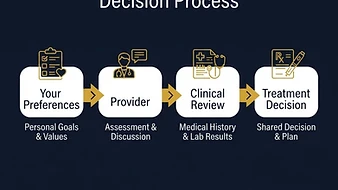
Who Decides If GLP-1 Treatment Is Appropriate?
Completing an online form or choosing a GLP-1 provider does not guarantee a prescription. Learn who makes the medical decision, what provider review may involve, and why eligibility, insurance coverage, and provider matching are different things.