
Who Decides If GLP-1 Treatment Is Appropriate?
Completing an online form or choosing a GLP-1 provider does not guarantee a prescription. Learn who makes the medical decision, what provider review may involve, and why eligibility, insurance coverage, and provider matching are different things.
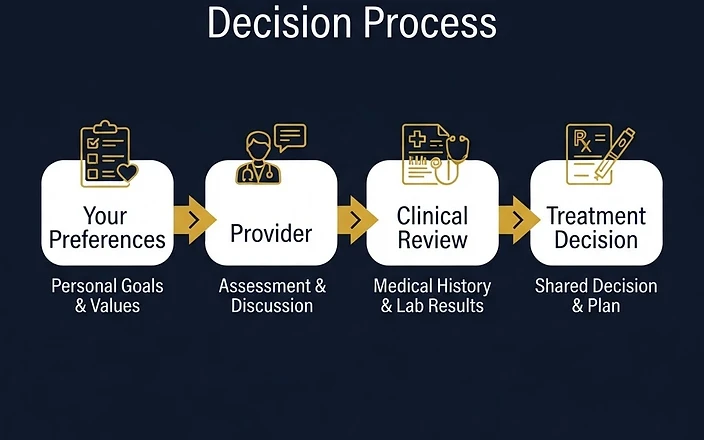
Who Decides If GLP-1 Treatment Is Appropriate?
You complete an online form.
You choose a telehealth provider.
You may even know which medication you are interested in.
But none of those steps determines whether GLP-1 treatment is medically appropriate for you.
That decision belongs to an appropriately licensed healthcare professional with authority to evaluate and prescribe treatment under the laws that apply where you are located.
Provider matching, medical review, prescription decisions, and insurance coverage are related — but they are not the same thing.
Medication information reviewed September 2026.
Educational information only. GoLean Horizon does not provide medical advice, diagnose conditions, prescribe medication, or determine treatment eligibility. A licensed healthcare professional determines whether treatment is medically appropriate.
Four Different Decisions Are Often Confused
It helps to separate four questions.
| Question | Who Generally Handles It? |
|---|---|
| Which provider would I like to explore? | You |
| Which participating providers fit my stated preferences? | A comparison or matching service can help organize options |
| Is a prescription medically appropriate? | An authorized licensed healthcare professional |
| Will insurance pay for it? | Your health plan, based on its coverage rules |
A person can therefore:
- match with a provider
- complete an intake
- undergo clinical review
and still not receive the medication originally expected.
Similarly, a clinician may prescribe a medication while an insurer later determines that its plan requirements for coverage have not been met.
These are different decisions.
Provider Matching Is Not Medical Approval
A provider-matching service can help consumers compare factors such as:
- cost
- flexibility
- support
- medication or treatment-form options
- insurance assistance
- online experience
But those preferences are not a medical evaluation.
Choosing a provider means:
"This is a provider I would like to explore."
It does not mean:
"I have been medically approved for this medication."
At GoLean Horizon, the provider-comparison process is designed to help organize participating options around consumer preferences.
It does not diagnose, prescribe, or determine treatment eligibility.
Who Can Make the Prescription Decision?
The exact type of healthcare professional who may prescribe depends on:
- professional licensure
- state law
- scope-of-practice rules
- the state where the patient is located
- the healthcare organization's structure
- other applicable requirements
Depending on the jurisdiction and circumstances, authorized prescribers may include physicians and certain other licensed professionals with prescribing authority.
Because these rules vary, it is more accurate to say:
an appropriately licensed and authorized prescriber
rather than assuming every telehealth prescription must come from one particular professional title.
Why Does Your Location Matter?
Telehealth does not eliminate state licensing rules.
HHS explains that healthcare professionals must meet applicable licensing requirements and be licensed or otherwise legally permitted to practice in the state where the patient is located.
That is why telehealth services commonly ask:
"What state are you currently in?"
The answer can affect:
- which clinicians can treat you
- whether a provider serves your location
- what telehealth rules apply
Some clinicians use full state licenses.
Others may qualify through interstate compacts, telehealth registrations, reciprocity, or other pathways permitted by state law.
The important issue is that the clinician must have legal authority to provide the care.
What Happens During Provider Review?
There is no single GLP-1 review process used by every telehealth provider.
Depending on the provider and the patient's situation, review may include information about:
- medical history
- current medications
- allergies
- previous treatment
- symptoms or concerns
- relevant health conditions
- weight or other measurements when appropriate
- pharmacy information
- treatment goals
- other clinical information
The clinician may also determine that more information is needed.
HHS telehealth workflow guidance describes intake as potentially involving identity verification, symptoms, medical history, and appropriate measurements.
Does Provider Review Have to Be a Video Visit?
Not necessarily in every situation.
Telehealth can occur in different formats.
Some care is delivered through real-time:
video or telephone interaction
Other telehealth models may use:
asynchronous review
where the patient submits information and the provider reviews it later.
HHS recognizes asynchronous telehealth as a model in which health information, medical history, reports, messages, or other information may be sent for later provider review.
Whether a particular format is legally and clinically appropriate depends on the type of care and applicable state requirements.
The important issue is not simply whether a video call occurred.
It is whether an appropriate clinical evaluation occurred through a legally permitted process.
Completing a Questionnaire Does Not Guarantee a Prescription
An online intake can provide useful clinical information.
But filling it out does not create an entitlement to medication.
After review, the clinician may decide to:
- prescribe a medication
- request more information
- request testing
- schedule another visit
- discuss another treatment option
- recommend in-person evaluation
- decide that the requested treatment is not appropriate
FDA currently warns consumers about telehealth companies offering GLP-1 drugs without appropriate screening and a prescription from a licensed clinician.
That is why phrases such as:
"Guaranteed GLP-1 prescription"
deserve careful scrutiny.
Why Might a Clinician Need More Information?
The information on an initial form may not answer every relevant clinical question.
For example, a clinician might need clarification about:
- another medication
- a medical condition
- previous treatment
- symptoms
- an allergy
- laboratory results
- pregnancy-related considerations
- previous adverse reactions
The exact questions vary by medication and individual.
Requesting more information does not necessarily mean there is a problem.
It may simply be part of responsible clinical evaluation.
FDA Approval Does Not Mean a Medication Is Right for Everyone
An FDA-approved medication has been reviewed for specific uses and populations.
But FDA approval does not mean:
everyone with excess weight should receive it
or
everyone who meets one label criterion should automatically receive a prescription.
FDA-approved labeling includes:
- indications
- dosing instructions
- contraindications
- warnings
- precautions
- adverse reactions
- drug-specific considerations
The clinician applies that information to the individual patient.
For example, current Wegovy labeling includes specific approved populations as well as important contraindications and safety warnings.
So eligibility is not simply a box-checking exercise.
Body Weight Alone Does Not Make the Entire Decision
Consumers often see weight-management medication described using body-mass-index criteria.
Those criteria can be relevant to particular FDA indications.
But a prescribing decision can involve considerably more than one number.
A clinician may consider factors such as:
- the condition being treated
- relevant medical history
- current medications
- contraindications
- potential risks
- previous treatments
- treatment goals
- ability to use the medication safely
- appropriate follow-up
A number on a scale does not replace clinical evaluation.
Medication Preference Is Not the Same as Medication SelectionA consumer may reasonably say:
"I'm interested in semaglutide."
or
"I'd prefer an oral option."
or
"I'd like to learn about tirzepatide."
That preference can help guide a conversation.
Explore My Options
Compare provider options based on factors such as cost, flexibility, support, medication preferences, and overall experience.
Explore My OptionsGoLean Horizon provides educational information and provider-matching resources. A licensed healthcare provider determines whether treatment is medically appropriate.
But it does not determine the prescription.
The provider may conclude that:
- the requested medication is appropriate
- another option should be discussed
- additional evaluation is needed
- prescription treatment is not appropriate
For an overview of medication differences, read:
Semaglutide vs Tirzepatide: What's the Difference?
Insurance Approval Is a Separate Process
One of the most common sources of confusion is the difference between:
clinical approval
and
insurance coverage
A clinician might determine that a medication is medically appropriate.
The health plan might still require:
- formulary coverage
- prior authorization
- documentation
- specific medical criteria
- use of an in-network pharmacy
- deductible or cost sharing
Conversely, the fact that a medication appears on an insurance formulary does not mean a clinician is required to prescribe it.
The clinician and insurer are answering different questions.
For more detail, read:
Does Insurance Cover GLP-1 Medications? What to Check With Your Health Plan
Paying Cash Does Not Eliminate Clinical Review
Another misconception is:
"If I'm paying out of pocket, I don't need approval."
Self-pay may remove some insurance requirements.
It does not remove the requirement for an appropriate prescription when the medication is prescription-only.
Payment method and medical appropriateness are different issues.
A legitimate prescription process still requires an authorized healthcare professional to determine whether prescription treatment is appropriate.
What About Compounded GLP-1 Medications?
Clinical review still matters.
FDA states that compounded drugs are not FDA approved and do not undergo FDA premarket review for safety, effectiveness, and quality.
FDA's current guidance says compounded drugs should generally be used only when a patient's medical needs cannot be met by an FDA-approved drug.
FDA also recommends that patients obtain a prescription from a healthcare professional and fill it through a state-licensed pharmacy.
So:
compounded does not mean prescription-free
and
compounded does not mean clinical review is unnecessary.
Can an Algorithm Decide Whether I Get a GLP-1?
Technology can assist healthcare workflows.
For example, software may help:
- collect intake information
- organize records
- flag missing information
- schedule visits
- support communication
- present information to clinicians
But a consumer-facing matching tool should not be confused with the licensed clinical decision-maker.
If a website says that you "match" with a particular provider, that is not the same thing as a clinician deciding that a particular prescription is appropriate.
What If the Provider Says No?
A clinician deciding not to prescribe the medication you expected does not necessarily mean the telehealth process failed.
There may be several possible next steps.
The clinician might:
- explain the reason
- request additional information
- discuss another option
- recommend testing
- recommend another healthcare professional
- suggest in-person evaluation
A consumer can ask:
"Can you explain the reason for this decision and what the next step is?"
You should understand the plan even when the result differs from what you hoped for.
What If I Disagree With the Decision?
You can ask questions.
Useful questions include:
What factors affected the decision?
Is additional information needed?
Are there other options to discuss?
Should I follow up with my primary-care clinician or another specialist?
Seeking clarification is different from demanding a particular prescription.
Prescription treatment remains a clinical decision.
What Happens After the Clinical Decision?
If medication is prescribed, additional steps can still remain.
These may include:
- pharmacy processing
- insurance authorization
- self-pay arrangements
- medication instructions
- laboratory work where appropriate
- follow-up
- refill review
That is why prescription approval is not always the final step in the process.
Read:
What Happens After You Sign Up for a GLP-1 Telehealth Program?
Questions to Ask Before Provider Review
Before completing a telehealth evaluation, you may want to know:
- Who performs the clinical review?
- Is that clinician legally permitted to treat patients in my state?
- What information will I need to provide?
- Is a video appointment required?
- Could laboratory testing be requested?
- How will I receive the clinical decision?
- Can I ask the clinician questions?
- What happens if treatment is not recommended?
- Which pharmacy is used if medication is prescribed?
- How does follow-up work?
For a broader checklist, read:
7 Questions to Ask Before Choosing a GLP-1 Provider
Provider Review: What Each Party Does
| Participant | Role |
|---|---|
| Consumer | Provides accurate information and chooses which provider to explore |
| Comparison platform | Organizes provider information or options |
| Clinical staff | May collect information and support the care process |
| Licensed prescriber | Evaluates clinical information and makes prescribing decisions |
| Pharmacy | Dispenses an authorized prescription |
| Health insurer | Determines coverage under the person's plan |
Understanding these separate roles helps prevent confusion.
Red Flags Worth Clarifying
Be cautious if a service appears to:
- guarantee a prescription before clinical review
- advertise that everyone qualifies
- provide prescription medication without appropriate screening
- hide who provides the clinical care
- avoid identifying the dispensing pharmacy
- provide no way to ask clinical questions
- treat payment as automatic medical approval
FDA specifically advises consumers to obtain prescription medications through appropriate clinical review and state-licensed pharmacies.
The Bottom Line
So who decides whether GLP-1 treatment is appropriate?
An appropriately licensed healthcare professional with prescribing authority makes the clinical decision.
Not:
an advertisement
Not:
a quiz
Not:
an affiliate website
Not:
an insurance company
Not:
a payment confirmation
And not:
a consumer's medication preference by itself.
A comparison service can help you decide which provider you would like to explore.
An insurer can decide whether your plan will pay.
A pharmacy can dispense an authorized prescription.
But the medical decision belongs to the licensed clinical professional responsible for evaluating you.
That distinction is central to responsible telehealth care.
Explore Participating Provider Options
GoLean Horizon helps you compare participating providers based on preferences such as cost, flexibility, provider support, medication interest, treatment form, insurance assistance, and simplicity.
Choosing a provider through GoLean Horizon is not medical approval and does not guarantee a prescription.
Explore My Options
GoLean Horizon provides educational information and provider-matching resources. We do not provide medical advice, diagnose conditions, prescribe medication, recommend treatment, or determine treatment eligibility. A licensed healthcare professional determines whether treatment is medically appropriate.
Sources & References
- 1.Telehealth.HHS.gov — Getting Started With Licensure
- 2.Telehealth.HHS.gov — Licensing Across State Lines
- 3.Telehealth.HHS.gov — Planning Your Telehealth Workflow
- 4.Telehealth.HHS.gov — Asynchronous Direct-to-Consumer Telehealth
- 5.FDA — Concerns With Unapproved GLP-1 Drugs Used for Weight Loss
- 6.FDA — Wegovy Prescribing Information
Frequently Asked Questions
Who decides whether I qualify for GLP-1 treatment?
An appropriately licensed healthcare professional with prescribing authority evaluates your individual clinical information and determines whether prescription treatment is appropriate. Provider matching, payment, or completion of an online form does not itself constitute medical approval.
Can a GLP-1 telehealth website automatically approve me for medication?
A website can collect information or help organize provider options, but prescription treatment requires an appropriate clinical process. FDA recommends obtaining prescription GLP-1 medications through a healthcare professional and a state-licensed pharmacy.
Does the provider have to be licensed in my state?
HHS says healthcare professionals must be licensed or otherwise legally permitted to practice where the patient is located. Cross-state options vary and can include full licensure, compacts, reciprocity, or telehealth registration.
Does GLP-1 provider review always require a video appointment?
Not necessarily. HHS recognizes both real-time and asynchronous telehealth models. The legally and clinically appropriate process depends on the service and applicable state requirements.
If my insurance covers a GLP-1 medication, does that mean the provider must prescribe it?
No. Insurance coverage and medical appropriateness are different decisions. The health plan determines benefits under the policy, while the licensed prescriber makes the clinical decision.
If I pay cash, can I skip provider review?
No. Self-pay changes how a service or medication is paid for; it does not turn a prescription medication into a nonprescription product.
Can a provider decide that I need more information or testing first?
Yes. Telehealth workflows may involve medical history, symptoms, measurements when appropriate, and additional clinical information. A clinician can request more information or further evaluation before making a treatment decision.
Explore My Options
Compare provider options based on factors such as cost, flexibility, support, medication preferences, and overall experience.
Explore My OptionsGoLean Horizon provides educational information and provider-matching resources. A licensed healthcare provider determines whether treatment is medically appropriate.
Educational information only. GoLean Horizon does not provide medical advice, prescribe medication, or determine treatment eligibility. A licensed healthcare provider determines whether treatment is medically appropriate.
Continue Learning


Does Insurance Cover GLP-1 Medications? What to Check With Your Health Plan
GLP-1 insurance coverage varies by medication, health plan, medical indication, and coverage rules. Learn how to check your formulary, prior authorization, deductible, copay, pharmacy network, Medicare GLP-1 Bridge, and appeal options.


Semaglutide vs Tirzepatide: What's the Difference?
Semaglutide and tirzepatide are both used in FDA-approved medications for weight management and type 2 diabetes, but they work differently. Learn about GLP-1 vs GIP/GLP-1 activity, indications, weight-loss evidence, side effects, dosing, and other differences.


7 Questions to Ask Before Choosing a GLP-1 Provider
Before choosing a GLP-1 telehealth provider, ask what the price includes, who reviews your information, whether medication and follow-up are included, how refills work, and what requirements apply.


How to Compare GLP-1 Providers: What Matters Most?
Different people prioritize different things when comparing GLP-1 providers. Learn how to compare cost, flexibility, support, medication options, insurance help, simplicity, and the overall care experience.