
How to Compare GLP-1 Providers: What Matters Most?
Different people prioritize different things when comparing GLP-1 providers. Learn how to compare cost, flexibility, support, medication options, insurance help, simplicity, and the overall care experience.

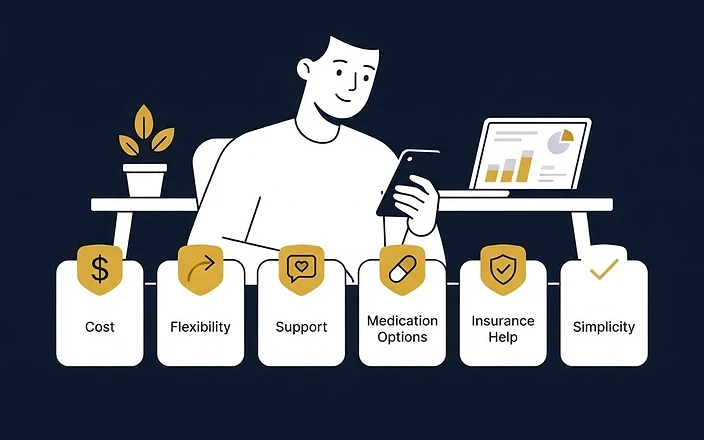
Table of Contents
- There Is No Single Factor That Matters Most to Everyone
- Priority 1: Overall Cost
- If Cost Is Your Main Priority
- Priority 2: Month-to-Month Flexibility
- Flexibility Is More Than the Billing Schedule
- Priority 3: Provider Support and Follow-Up
- Priority 4: Medication and Treatment-Form Options
- Ask What Type of Medication Is Being Discussed
- Priority 5: Insurance and Payment Support
- Priority 6: A Simple Online Experience
- Simplicity Should Not Mean Skipping Appropriate Medical Review
- Priority 7: Provider Availability in Your State
- Priority 8: Pharmacy Transparency
- Priority 9: Privacy and Communication
- Priority 10: What Happens After Signup?
- Start With Your Top Three Priorities
- Person A
- Person B
- Person C
- A Preference-Based Provider Comparison
- Compare Facts Before Preferences
- A Low Price Does Not Automatically Mean Poor Support
- More Features Do Not Automatically Mean a Better Fit
- Provider Comparison Should Not Replace Clinical Judgment
- A Simple Six-Factor Framework
- 1. Cost
- 2. Flexibility
- 3. Support
- 4. Options
- 5. Insurance
- 6. Simplicity
- Questions to Ask Yourself
- The Bottom Line
Different people can look at the same GLP-1 telehealth programs and prefer different options.
One person may care most about:
lower overall cost
Another may prioritize:
month-to-month flexibility
Someone else may value:
provider support and follow-up
Others may care more about:
medication options
insurance assistance
or
a simple online experience
That is why comparing GLP-1 providers should involve more than searching for the lowest advertised price.
The goal is to understand how the providers differ — and decide which differences matter most to you.
Educational information only. GoLean Horizon does not provide medical advice, prescribe medication, determine treatment eligibility, or select a provider for you. A licensed healthcare provider determines whether treatment is medically appropriate.
There Is No Single Factor That Matters Most to Everyone
It is tempting to ask:
"Which GLP-1 provider is best?"
But that question leaves out something important:
Best for what?
A provider that appeals to someone focused primarily on price may look very different from one preferred by someone who values frequent follow-up or insurance assistance.
A useful comparison therefore begins with your priorities.
Ask yourself:
What matters most to me about the provider experience?
For a practical checklist of questions to ask each provider, read:
7 Questions to Ask Before Choosing a GLP-1 Provider
Priority 1: Overall Cost
For many people, cost is the first thing they compare.
But the lowest displayed number may not represent the entire program.
Your actual cost could involve:
- provider fees
- membership
- medication
- follow-up visits
- laboratory testing
- shipping
- supplies
- insurance-related costs
Current telehealth pricing illustrates why this matters.
LillyDirect's current obesity telehealth comparison page states that the rates reported by the independent providers shown there do not include medication costs.
So a provider-service price should not automatically be interpreted as the total treatment cost.
Ask:
What is the estimated total cost, not just the headline price?
For the complete pricing framework, read:
GLP-1 Costs Explained: How to Compare Provider Prices
If Cost Is Your Main Priority
Compare:
- amount due today
- regular recurring cost
- medication cost
- membership fee
- provider visits
- shipping
- laboratory costs
- prepaid commitments
- cancellation terms
Use the same cost categories for each provider.
Do not compare one provider's introductory price with another provider's normal recurring price.
Priority 2: Month-to-Month Flexibility
Some people prefer not to make a long financial commitment.
If flexibility matters to you, ask:
- Is the program month-to-month?
- Is prepayment required?
- Does it automatically renew?
- How do I cancel?
- Is there a cancellation deadline?
- Are prepaid amounts refundable?
- Can I pause the program?
- What happens if my needs change?
A prepaid program may offer a lower monthly equivalent.
A monthly program may require less money upfront.
Neither structure is automatically preferable.
The question is which payment arrangement better matches your priorities.
Flexibility Is More Than the Billing Schedule
Also consider what happens if:
- your provider changes the treatment plan
- insurance coverage changes
- you want to change providers
- medication pricing changes
- you no longer want the service
The cancellation and refund terms can matter as much as the monthly price.
Priority 3: Provider Support and Follow-Up
Some people want a relatively simple telehealth service.
Others place significant value on ongoing provider access.
If support matters to you, ask:
- Can I contact a clinician after signup?
- Is secure messaging available?
- What response time should I expect?
- Are follow-up visits included?
- How are refills handled?
- Are additional visits extra?
- How are laboratory results communicated?
- Who do I contact with clinical questions?
HHS encourages telehealth patients to understand how care works, ask questions, and know what to expect from the provider. FDA currently identifies the absence of a licensed doctor available to answer questions after receiving GLP-1 medication as a telehealth warning sign.
For a detailed comparison, read:
Provider Support Matters: What Good GLP-1 Follow-Up Should Look Like
Priority 4: Medication and Treatment-Form Options
Some consumers begin their search already interested in a particular medication or treatment format.
Others are unsure.
You might be interested in:
- semaglutide
- tirzepatide
- injectable treatment
- oral treatment when available and appropriate
- learning about available options before deciding
But provider comparison should not become self-prescribing.
A licensed healthcare provider determines whether a medication or treatment form is medically appropriate.
The useful consumer question is:
"What options does this provider evaluate and offer when clinically appropriate?"
rather than:
"Can I guarantee that I will receive this medication?"
Ask What Type of Medication Is Being Discussed
Also determine whether the provider offers:
- FDA-approved medications
- compounded medications in circumstances where appropriate
- both
FDA states that compounded drugs are not FDA-approved and do not undergo FDA premarket review for safety, effectiveness, and quality.
FDA advises patients to obtain prescriptions from licensed clinicians and fill them through state-licensed pharmacies.
Understanding what type of medication is involved should be part of your comparison.
Priority 5: Insurance and Payment Support
Insurance can make the provider experience significantly more complicated.
If using insurance matters to you, ask:
- Does the provider accept insurance for visits?
- Does the provider assist with prior authorization?
- Will the provider help with required documentation?
- Can you use your preferred pharmacy?
- Does the provider offer self-pay alternatives?
- Are membership fees separate from insurance-covered services?
HHS notes that telehealth costs depend on the healthcare provider and insurance coverage and recommends contacting the insurer or provider before the visit to understand what you may pay.
For a detailed insurance guide, read:
Does Insurance Cover GLP-1 Medications? What to Check With Your Health Plan
Priority 6: A Simple Online Experience
For some people, convenience matters greatly.
A provider may offer:
- mobile-friendly intake
- patient portal
- online scheduling
- secure messaging
- digital refill requests
- pharmacy coordination
- automatic reminders
Another program may require more phone calls, live appointments, or manual steps.
Neither approach is automatically better.
Ask:
"How easy is it for me to complete the steps this program requires?"
HHS notes that telehealth may involve video, messaging, portals, electronic forms, and other digital tools.
A system that feels easy for one person may feel complicated to someone else.
Simplicity Should Not Mean Skipping Appropriate Medical Review
There is an important distinction between:
a convenient process
and
an inadequate clinical process
A smooth online experience should still involve appropriate medical evaluation.
FDA currently advises consumers to be cautious about telehealth companies that provide GLP-1 medication without screening and a prescription from a licensed clinician.
Convenience should not replace clinical review.
Priority 7: Provider Availability in Your State
Explore My Options
Compare provider options based on factors such as cost, flexibility, support, medication preferences, and overall experience.
Explore My OptionsGoLean Horizon provides educational information and provider-matching resources. A licensed healthcare provider determines whether treatment is medically appropriate.
A provider may look appealing but not be able to provide care where you are located.
Telehealth licensure is generally tied to the patient's location.
HHS states that health professionals must meet applicable licensing requirements and be licensed or otherwise legally permitted to practice in the state where the patient is located.
So before comparing a provider too deeply, confirm:
Does this provider serve my state?
Provider availability can change as telehealth organizations add or remove licensed clinicians.
Priority 8: Pharmacy Transparency
If medication is prescribed, you should understand where it will be dispensed.
Ask:
- Which pharmacy fills the prescription?
- Is the pharmacy state licensed?
- Is a pharmacist available for questions?
- Is home delivery available?
- Can I use another pharmacy?
FDA advises consumers obtaining prescription medication online to look for a pharmacy that:
- requires a prescription
- provides a U.S. address and telephone number
- has a licensed pharmacist available
- is licensed through the appropriate state board of pharmacy
If you cannot identify the pharmacy, get clarification.
Priority 9: Privacy and Communication
Telehealth involves sharing health information electronically.
You may care about:
- patient portal security
- privacy policy
- messaging system
- how health information is handled
- whether communications are easy to access
- whether you receive visit summaries
HHS advises patients to understand their privacy rights and how health information is protected during telehealth care.
Privacy may not be the first comparison factor people think about, but it is part of the overall provider experience.
Priority 10: What Happens After Signup?
A polished signup page does not tell you what ongoing care will look like.
Ask:
- What happens after I submit the intake?
- Who reviews it?
- Will I need a live visit?
- Could additional information be requested?
- How will I receive the decision?
- Which pharmacy is used?
- How does follow-up work?
- How are refills managed?
For the full process, read:
What Happens After You Sign Up for a GLP-1 Telehealth Program?
Start With Your Top Three Priorities
Trying to compare every feature at once can become overwhelming.
A simpler approach is to identify your top three priorities.
For example:
Person A
- Lowest overall cost
- Month-to-month flexibility
- Simple online experience
Person B
- Provider support
- Insurance assistance
- Follow-up
Person C
- Medication/form options
- Cost
- Refill convenience
All three people may look at the same provider information differently.
That is normal.
Provider comparison is useful precisely because priorities differ.
A Preference-Based Provider Comparison
Use a worksheet like this:
| Comparison Area | Importance to Me | Provider A | Provider B | Provider C |
|---|---|---|---|---|
| Overall cost | High / Medium / Low | |||
| Month-to-month flexibility | High / Medium / Low | |||
| Provider support | High / Medium / Low | |||
| Follow-up | High / Medium / Low | |||
| Medication/form options | High / Medium / Low | |||
| Insurance assistance | High / Medium / Low | |||
| Simple online experience | High / Medium / Low | |||
| Refill process | High / Medium / Low | |||
| Pharmacy transparency | High / Medium / Low | |||
| Cancellation flexibility | High / Medium / Low |
The goal is not to create a universal provider ranking.
It is to organize the information around your priorities.
Compare Facts Before Preferences
Preference-based comparison works best after basic safety and program facts are established.
Before comparing convenience or price, confirm that you understand:
- who provides clinical care
- whether appropriate screening occurs
- how prescriptions are handled
- which pharmacy dispenses medication
- how follow-up works
- what the program actually costs
Then compare the features that matter most to you.
A Low Price Does Not Automatically Mean Poor Support
It is also important not to assume that:
lower price = worse care
or
higher price = better care
Price alone does not establish quality.
A lower-cost provider may have a model that works well for your needs.
A higher-priced program may bundle services you value.
The useful approach is to compare documented features rather than making assumptions based on price alone.
More Features Do Not Automatically Mean a Better Fit
Similarly:
more services ≠ automatically better
If a provider includes coaching, frequent follow-ups, insurance support, and several digital tools, those services may be valuable to some consumers.
Another person may prefer a simpler experience.
The important question is:
"Am I paying for features I actually value?"
Provider Comparison Should Not Replace Clinical Judgment
GoLean Horizon can help organize participating providers based on preferences.
But provider matching and medical decision-making are different.
GoLean Horizon does not determine:
- whether GLP-1 treatment is appropriate
- which medication is appropriate
- what dose is appropriate
- whether a prescription should be issued
Those decisions belong to the licensed healthcare provider.
Your role in provider comparison is to decide which service structure you want to explore.
The clinician's role is to determine medically appropriate care.
A Simple Six-Factor Framework
If you want the shortest possible comparison, start here:
1. Cost
What is the expected total cost?
2. Flexibility
What commitment and cancellation terms apply?
3. Support
What access do you have after signup?
4. Options
What treatment options does the provider evaluate when clinically appropriate?
5. Insurance
How does the program handle insurance, prior authorization, or self-pay?
6. Simplicity
How easy is the process for you to use?
Those six categories capture many of the differences consumers encounter.
Questions to Ask Yourself
Before selecting a provider to explore further, ask:
- What are my top three priorities?
- How important is the lowest overall cost?
- Do I want month-to-month flexibility?
- How much provider support do I want?
- Do I need help navigating insurance?
- How important is a simple digital experience?
- Do I care about specific medication or treatment-form options?
- What cancellation commitment am I comfortable with?
- Do I understand how refills work?
- Do I understand what happens after signup?
Your answers can make provider comparison much clearer.
The Bottom Line
There is no single provider feature that matters most to everyone.
Different people may prioritize:
cost
flexibility
provider support
follow-up
medication or treatment-form options
insurance assistance
or
simplicity
The most useful provider comparison begins by identifying which factors matter most to you.
Then compare participating providers using the same categories.
That is the principle behind preference-based provider matching:
Understand the differences. Identify your priorities. Compare from there.
Sources & References
- 1.https://telehealth.hhs.gov/patients/what-should-i-know-before-my-telehealth-visit
- 2.https://telehealth.hhs.gov/patients/how-do-i-pay-for-telehealth
- 3.https://telehealth.hhs.gov/providers/getting-started-with-licensure
- 4.https://www.fda.gov/consumers/consumer-updates/fdas-concerns-unapproved-glp-1-drugs-used-weight-loss
- 5.https://www.lillydirect.com/obesity/telehealth
- 6.https://telehealth.hhs.gov/patients/helping-patients-prepare-their-telehealth-appointment
Frequently Asked Questions
What should I compare when choosing a GLP-1 telehealth provider?
Useful comparison factors include total cost, payment flexibility, provider support, follow-up, medication or treatment-form options, insurance assistance, refill process, pharmacy transparency, and ease of using the service.
Is the cheapest GLP-1 provider always the best choice?
Not necessarily. A lower price may include fewer services, while a higher price may bundle services you value. Compare the documented total cost and included features rather than assuming price alone reflects the overall experience.
How important is provider support?
That depends on your preferences, but you should understand how clinical questions, follow-up, refills, and treatment changes are handled. FDA currently identifies lack of clinician access after receiving GLP-1 medication as a telehealth warning sign. U.S. Food and Drug Administration
Can I choose a GLP-1 provider based on the medication I want?
You can compare which options providers evaluate or offer, but a licensed healthcare provider determines whether a medication or treatment form is medically appropriate.
Why does my state matter when choosing a telehealth provider?
Telehealth providers must meet applicable legal and licensing requirements where the patient is located. Provider availability can therefore differ by state. telehealth.hhs.gov
Should I consider insurance support when comparing providers?
Yes, if using insurance matters to you. HHS notes that telehealth cost depends partly on insurance coverage and recommends checking with the insurer or provider about expected costs. telehealth.hhs.gov
How does GoLean Horizon's preference-based matching work?
You identify factors that matter to you—such as cost, flexibility, support, medication preferences, insurance/payment support, or simplicity—and GoLean Horizon organizes participating provider options around those preferences. GoLean does not make clinical treatment decisions.
Explore My Options
Compare provider options based on factors such as cost, flexibility, support, medication preferences, and overall experience.
Explore My OptionsGoLean Horizon provides educational information and provider-matching resources. A licensed healthcare provider determines whether treatment is medically appropriate.
Educational information only. GoLean Horizon does not provide medical advice, prescribe medication, or determine treatment eligibility. A licensed healthcare provider determines whether treatment is medically appropriate.
Continue Learning


Does Insurance Cover GLP-1 Medications? What to Check With Your Health Plan
GLP-1 insurance coverage varies by medication, health plan, medical indication, and coverage rules. Learn how to check your formulary, prior authorization, deductible, copay, pharmacy network, Medicare GLP-1 Bridge, and appeal options.


Provider Support Matters: What Good GLP-1 Follow-Up Should Look Like
GLP-1 provider support can vary after signup. Learn what to ask about follow-up, clinician access, messaging, refills, test results, treatment changes, and additional fees.


7 Questions to Ask Before Choosing a GLP-1 Provider
Before choosing a GLP-1 telehealth provider, ask what the price includes, who reviews your information, whether medication and follow-up are included, how refills work, and what requirements apply.
GLP-1 Costs Explained: How to Compare Provider Prices
GLP-1 pricing can be confusing. Learn how to compare medication costs, provider fees, memberships, labs, shipping, insurance, introductory offers, and ongoing monthly costs before choosing a provider.