
Does Insurance Cover GLP-1 Medications? What to Check With Your Health Plan
GLP-1 insurance coverage varies by medication, health plan, medical indication, and coverage rules. Learn how to check your formulary, prior authorization, deductible, copay, pharmacy network, Medicare GLP-1 Bridge, and appeal options.
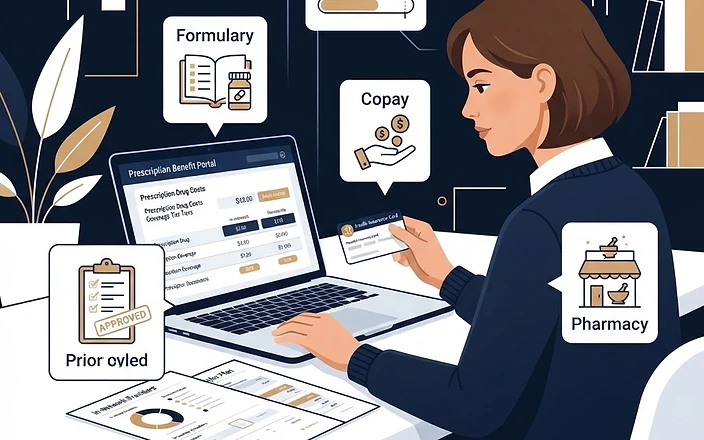
Table of Contents
- Why GLP-1 Coverage Is So Variable
- Step 1: Check the Formulary
- Covered Does Not Always Mean Automatically Approved
- Step 2: Ask Whether Prior Authorization Is Required
- What Should You Ask the Insurance Company?
- Step 3: Check the Approved Indication
- Step 4: Check Your Prescription-Drug Deductible
- Step 5: Understand Copay vs Coinsurance
- Copayment
- Coinsurance
- Step 6: Check the Drug Tier
- Step 7: Check Which Pharmacy You Must Use
- Step 8: Determine Whether Telehealth and Medication Are Billed Separately
- Step 9: Ask About Employer-Specific Coverage
- Step 10: Ask About the Total Out-of-Pocket Cost
- What If Your Insurance Says the Medication Is Not Covered?
- Can You Request a Formulary Exception?
- Can You Appeal a Denial?
- What About Manufacturer Savings Programs?
- What About Paying Cash Instead?
- Medicare Coverage: Important 2026 Update
- Medicare Can Also Cover GLP-1s for Other Indications
- What to Ask Your Insurance Company
- Don't Ask Only "Is It Covered?"
- How Insurance Fits Into Provider Comparison
- The Bottom Line
- Compare Participating Provider Options
A common question people ask about GLP-1 medications is whether insurance will help pay for them.
The short answer is:
Sometimes.
GLP-1 insurance coverage can vary significantly from one health plan to another.
A medication may be covered under one plan, excluded under another, or covered only when certain medical and administrative requirements are met.
Even when a medication is technically covered, you may still face:
- prior authorization
- a deductible
- copayments
- coinsurance
- pharmacy-network restrictions
- quantity limits
- plan-specific eligibility criteria
That is why the most useful question is not simply:
"Does insurance cover GLP-1s?"
A better question is:
"Does my specific health plan cover this specific medication for the reason it is being prescribed, and what will I actually pay?"
Educational information only. GoLean Horizon does not provide medical advice, prescribe medication, determine treatment eligibility, or determine insurance coverage. Coverage decisions are made by health plans according to their current benefit rules. A licensed healthcare provider determines whether treatment is medically appropriate.
Why GLP-1 Coverage Is So Variable
Insurance coverage depends on several separate factors.
These can include:
- the specific medication
- the condition or indication for which it is prescribed
- your health plan
- your employer's benefit design
- your prescription-drug formulary
- prior-authorization requirements
- the pharmacy you use
- your deductible
- copayment or coinsurance rules
Two people taking the same medication could therefore have very different out-of-pocket costs.
One might pay a fixed copay.
Another might pay coinsurance.
Another might need to meet a prescription deductible first.
And another person's plan may not cover that medication at all.
For the broader pricing picture, read:
GLP-1 Costs Explained: How to Compare Provider Prices
Step 1: Check the Formulary
A formulary, also called a drug list, is the list of prescription medications covered by an insurance plan.
This should be one of your first checks.
HealthCare.gov recommends reviewing your insurer's drug list, Summary of Benefits and Coverage, insurance website, or contacting the insurer directly to determine whether a medication is covered.
Look up the exact medication name.
Do not assume that because one GLP-1 medication is covered, all medications in the same class are covered.
Ask:
Is this medication on my formulary?
If yes, continue to the next question:
Under what conditions is it covered?
Covered Does Not Always Mean Automatically Approved
Finding a medication on the formulary does not necessarily mean the prescription will be filled without additional steps.
A plan may apply utilization-management requirements such as:
- prior authorization
- quantity limits
- preferred-drug rules
- other plan-specific criteria
The exact requirements vary.
That is why the insurer's coverage policy matters just as much as the name appearing on the drug list.
Step 2: Ask Whether Prior Authorization Is Required
Prior authorization means the health plan requires additional information before agreeing to cover the medication.
Your healthcare provider may need to submit documentation showing that the plan's coverage criteria are met.
That could involve clinical information relevant to the prescribed indication.
The important point is:
A prescription from your healthcare provider does not automatically guarantee that your insurance company will pay for it.
The provider makes the clinical prescribing decision.
The insurer makes the coverage decision under the terms of the health plan.
Those are separate processes.
What Should You Ask the Insurance Company?
Call the member-services number on your insurance card and ask:
Does this medication require prior authorization?
Then ask:
- What are the current coverage criteria?
- Who submits the prior authorization?
- What documentation is required?
- How long does approval usually last?
- Will another authorization be required for refills?
- Does the authorization need to be renewed periodically?
Write down the representative's name or reference number if one is provided.
Step 3: Check the Approved Indication
Insurance coverage can depend on why the medication is being prescribed.
Some GLP-1 medicines have more than one FDA-approved indication.
That matters because an insurer may cover a medication for one approved use while applying different rules—or not providing coverage—for another.
For example, Wegovy has an FDA-approved indication to reduce the risk of cardiovascular death, heart attack, and stroke in certain adults with established cardiovascular disease and overweight or obesity.
Coverage for a specific person still depends on the health plan and its rules.
The medication's FDA-approved indication does not, by itself, guarantee insurance payment.
Step 4: Check Your Prescription-Drug Deductible
Even when a medication is covered, you may have to pay toward a deductible before your insurance begins sharing more of the cost.
A deductible is the amount you pay for covered services or medications before the plan begins paying according to its benefit design.
Some plans have:
- one overall medical deductible
while others may have:
- a separate prescription-drug deductible
That means the price you pay early in the year can sometimes be different from what you pay after meeting the deductible.
Ask:
Do I have a prescription-drug deductible?
How much of it have I already met?
Does this medication apply toward it?
HealthCare.gov notes that some plans have separate deductibles for prescription drugs.
Step 5: Understand Copay vs Coinsurance
After coverage requirements are met, your share of the cost may be structured as either a copayment or coinsurance.
Copayment
A fixed amount.
Example:
$50 per prescription
Coinsurance
A percentage of the covered cost.
Example:
20% of the plan's allowed amount
These can produce very different out-of-pocket costs for expensive medications.
Ask your insurer:
Is this medication subject to a copay or coinsurance?
and:
What will my estimated out-of-pocket amount be?
HealthCare.gov defines cost sharing as including deductibles, copayments, and coinsurance.
Step 6: Check the Drug Tier
Many insurance formularies organize medications into tiers.
A plan may have categories such as:
- generic
- preferred brand
- non-preferred brand
- specialty medication
The exact tier structure varies.
Your cost sharing may be different depending on where the medication sits on the formulary.
Ask:
What tier is this medication on?
Then ask:
What copay or coinsurance applies to that tier?
Do not rely on another person's insurance experience.
Their plan may place the same medication on a different tier.
Step 7: Check Which Pharmacy You Must Use
Insurance plans may have preferred or in-network pharmacies.
HealthCare.gov specifically advises consumers to verify whether their regular pharmacy participates in their plan's network.
You may need to use:
- a preferred retail pharmacy
- mail-order pharmacy
- specialty pharmacy
- another designated pharmacy
Using a non-preferred or out-of-network pharmacy may increase the price or affect coverage.
Ask:
Which pharmacies can fill this prescription under my plan?
and:
Is there a lower cost at a preferred pharmacy?
Step 8: Determine Whether Telehealth and Medication Are Billed Separately
Insurance coverage for medication does not necessarily mean that every component of a telehealth program is covered.
You may be dealing with two separate costs:
Telehealth provider services
and
Prescription medication
The provider may charge a membership or consultation fee even if your insurance covers some or all of the medication cost.
For a deeper explanation, read:
What Does a GLP-1 Price Actually Include?
Before enrolling, ask both:
Will my insurance cover the medication?
and
Does my insurance cover the provider or telehealth service?
Those can be two different answers.
Step 9: Ask About Employer-Specific Coverage
If your insurance comes through an employer, the employer's benefit design can affect prescription coverage.
Two people insured by the same insurance company can have different coverage because they are enrolled in different employer plans.
Explore My Options
Compare provider options based on factors such as cost, flexibility, support, medication preferences, and overall experience.
Explore My OptionsGoLean Horizon provides educational information and provider-matching resources. A licensed healthcare provider determines whether treatment is medically appropriate.
That means hearing:
"My insurer covers it"
from a coworker, friend, or online forum does not necessarily tell you what your own plan covers.
Always verify your exact plan.
Step 10: Ask About the Total Out-of-Pocket Cost
Do not stop after hearing:
"Yes, it's covered."
Ask:
"What will I actually pay?"
Your cost could still depend on:
- deductible
- copayment
- coinsurance
- drug tier
- pharmacy
- quantity
- prior authorization
A covered medication can still have significant out-of-pocket expense.
HealthCare.gov recommends looking at total healthcare costs rather than one isolated number because deductibles, copays, and coinsurance can substantially affect what a person ultimately spends.
For more on comparing total program costs, read:
Cheapest Isn't Always Cheapest: How to Compare the Real Cost of a GLP-1 Program
What If Your Insurance Says the Medication Is Not Covered?
A denial does not always mean the process is finished.
First, find out why the medication was denied.
Possible reasons could include:
- the medication is not on the formulary
- prior authorization was not completed
- plan criteria were not met
- the pharmacy is out of network
- additional documentation is required
- the medication is excluded under the benefit
Ask for the reason in writing if available.
Then discuss the denial with the prescribing healthcare provider.
Can You Request a Formulary Exception?
Depending on the health plan and situation, there may be an exception process for a medication that is not normally covered.
HealthCare.gov explains that consumers can request exceptions in certain circumstances, such as when covered alternatives have not worked or are expected to cause harmful effects.
If an exception is granted, the plan may treat the requested medication as covered under its applicable cost-sharing rules.
The exact process depends on the plan.
Ask:
Does my plan have a formulary exception process?
and:
What information does my provider need to submit?
Can You Appeal a Denial?
Yes, insurance decisions may have appeal rights.
HealthCare.gov states that when an insurer refuses to pay a claim or denies certain coverage, consumers generally have the right to request an internal appeal and, in applicable situations, external review.
If you receive a denial:
- Read the denial notice.
- Identify the stated reason.
- Ask your provider whether additional documentation may be appropriate.
- Follow the insurer's appeal instructions and deadlines.
- Keep copies of everything submitted.
HealthCare.gov currently notes that internal appeals generally must be filed within 180 days of receiving the denial notice for the plans covered by its guidance.
Always follow the deadline stated by your own plan.
What About Manufacturer Savings Programs?
Manufacturer savings programs may reduce out-of-pocket costs for some eligible people.
But they are not the same as insurance coverage.
Eligibility requirements and program terms apply.
Some programs may be limited to people with certain types of commercial insurance.
Government-insured patients may have different rules.
Offers may also change.
When considering a savings program, ask:
- Am I eligible?
- How long does the program last?
- Is there a maximum benefit?
- Does it work with my insurance?
- Does the payment count toward my deductible?
- What happens when the program ends?
Do not assume today's promotional price will remain the same indefinitely.
What About Paying Cash Instead?
Sometimes people compare their insurance cost with a cash or self-pay option.
If you do this, find out whether paying outside insurance affects your deductible or out-of-pocket accumulation.
Payments for services or medications not processed through your insurance generally may not count toward your insurance deductible or out-of-pocket maximum.
That distinction can affect the true annual cost.
For the broader comparison between program pricing structures, see:
Month-to-Month vs Prepaid GLP-1 Programs: Which Payment Structure Fits You?
Medicare Coverage: Important 2026 Update
📌 Medicare information current as of September 2026. Medicare rules change — verify with Medicare.gov or 1-800-MEDICARE before relying on this section.
Current as of September 2026
Medicare coverage deserves special attention because the rules have changed.
Beginning July 1, 2026, Medicare launched the temporary Medicare GLP-1 Bridge program.
The program runs through December 31, 2027 and provides access to certain GLP-1 medications for eligible people with Medicare Part D drug coverage who meet the program's clinical requirements.
Medicare currently lists certain formulations of:
- Foundayo
- Wegovy
- Zepbound
as covered through the Bridge for eligible participants.
The current beneficiary copayment under the Bridge is $50 for a monthly supply.
Prior authorization is required.
Importantly, the Bridge operates outside the normal Part D benefit payment flow, and the $50 copayment does not count toward the beneficiary's Part D deductible or annual out-of-pocket limit.
Eligibility is not universal.
CMS uses specific age, BMI, medical-condition, Part D coverage, and prescribing criteria.
If you have Medicare, use Medicare.gov or contact 1-800-MEDICARE for the current eligibility rules rather than assuming you qualify.
Medicare Can Also Cover GLP-1s for Other Indications
The GLP-1 Bridge is not the only possible Medicare pathway.
CMS explains that GLP-1 medications may also be covered under regular Part D when prescribed for certain medically accepted indications that are coverable under Medicare.
CMS gives examples including:
- type 2 diabetes
- certain cardiovascular-risk reduction indications
- moderate-to-severe obstructive sleep apnea
- certain liver-disease indications
Coverage still depends on the medication, indication, plan rules, formulary, and utilization-management requirements.
Because Medicare rules are evolving, this section should be reviewed periodically for accuracy.
What to Ask Your Insurance Company
Before calling your insurer, have:
- your insurance card
- exact medication name
- dose or formulation if known
- prescribing provider information if requested
Then ask these questions:
| Question | Answer |
|---|---|
| Is this exact medication on my formulary? | |
| Is it covered for the prescribed indication? | |
| Is prior authorization required? | |
| What are the current coverage criteria? | |
| What drug tier is it on? | |
| Do I have a prescription deductible? | |
| How much of my deductible is left? | |
| What is my copay or coinsurance? | |
| Which pharmacies are in network? | |
| Is mail order required or available? | |
| Is there a quantity limit? | |
| How long does authorization last? | |
| Is an exception process available? | |
| What are my appeal rights if denied? | |
| What is my estimated out-of-pocket cost? |
Write down the answers.
Don't Ask Only "Is It Covered?"
The phrase:
"It's covered"
does not tell you enough.
A more useful insurance conversation is:
Is it covered for my prescribed indication?
Does it require prior authorization?
What tier is it on?
What deductible applies?
What pharmacy must I use?
What will I actually pay?
Those questions turn a vague yes-or-no answer into information you can use.
How Insurance Fits Into Provider Comparison
Insurance is only one part of the provider decision.
You may also want to compare:
- provider support
- follow-up
- refill process
- medication options
- membership fees
- cancellation terms
- insurance assistance
- overall program simplicity
Some people may prioritize insurance-navigation support.
Others may prefer a self-pay program with straightforward pricing.
Different priorities can lead to different provider choices.
GoLean Horizon's role is to help you compare participating provider options based on those preferences.
The Bottom Line
Insurance may cover a GLP-1 medication, but coverage is not universal.
Before assuming a medication is covered, check:
the exact medication
your formulary
the prescribed indication
prior authorization
drug tier
deductible
copay or coinsurance
pharmacy network
quantity limits
exception procedures
and
appeal rights
Then ask the question that matters most:
"What will my estimated out-of-pocket cost actually be?"
Your health plan is the best source for your specific coverage.
Coverage rules and costs can change, so verify them directly before making financial decisions.
Compare Participating Provider Options
Different people care about different things — including cost, flexibility, insurance support, provider support, and simplicity.
GoLean Horizon helps you compare participating provider options based on your preferences.
Explore My Options
GoLean Horizon provides educational information and provider-matching resources. We do not provide medical advice, prescribe medication, determine treatment eligibility, or determine insurance coverage. A licensed healthcare provider determines whether treatment is medically appropriate.
Sources & References
- 1.HealthCare.gov — Getting Prescription Medications: https://www.healthcare.gov/coverage/prescription-drugs/
- 2.HealthCare.gov — Your Total Costs for Health Care: https://www.healthcare.gov/choose-a-plan/your-total-costs/
- 3.HealthCare.gov — Appealing a Health Plan Decision: https://www.healthcare.gov/coverage/appealing-a-health-plan-decision/
- 4.Medicare.gov — Weight Loss Drugs: https://www.medicare.gov/coverage/weight-loss-drugs
- 5.CMS — Medicare GLP-1 Bridge: https://www.cms.gov/
- 6.CMS — Information for Part D Plans: https://www.cms.gov/Medicare/Prescription-Drug-Coverage/PrescriptionDrugCovContra
- 7.FDA — Wegovy Cardiovascular Indication: https://www.fda.gov/news-events/press-announcements/fda-approves-new-drug-treatment-chronic-weight-management-first-time-2014
Frequently Asked Questions
Does insurance cover GLP-1 medications for weight management?
It depends on the medication, insurance plan, prescribed indication, formulary, and plan-specific coverage criteria. Check your exact plan rather than assuming that coverage is the same across insurers or employers. (Source: HealthCare.gov)
What is a formulary?
A formulary is the health plan's list of covered prescription drugs. HealthCare.gov also refers to it as a drug list. (Source: HealthCare.gov)
What is prior authorization for a GLP-1 medication?
Prior authorization is a process in which the insurer requires additional information before approving coverage. The prescribing healthcare provider may need to submit documentation demonstrating that the plan's criteria are met. (Source: HealthCare.gov)
Can I appeal if my insurance denies a GLP-1 medication?
Depending on your plan and the reason for denial, appeal rights may be available. HealthCare.gov explains that insured consumers can generally pursue internal appeals and, in applicable circumstances, external review. (Source: HealthCare.gov)
Does a covered GLP-1 medication mean I will have a low copay?
Not necessarily. Your cost can depend on your deductible, drug tier, copayment, coinsurance, pharmacy network, and other plan rules. (Source: HealthCare.gov)
Does Medicare cover GLP-1 medications in 2026?
Medicare coverage depends on the drug, indication, and eligibility. As of September 2026, eligible Part D beneficiaries may have access to certain GLP-1 drugs through the temporary Medicare GLP-1 Bridge, while certain GLP-1s may also be coverable through regular Part D for other covered indications. (Source: Medicare.gov)
What is the Medicare GLP-1 Bridge?
It is a temporary CMS program running from July 1, 2026 through December 31, 2027 that provides certain qualifying Medicare Part D beneficiaries access to specified GLP-1 medications under defined eligibility criteria. (Source: CMS)
Explore My Options
Compare provider options based on factors such as cost, flexibility, support, medication preferences, and overall experience.
Explore My OptionsGoLean Horizon provides educational information and provider-matching resources. A licensed healthcare provider determines whether treatment is medically appropriate.
Educational information only. GoLean Horizon does not provide medical advice, prescribe medication, or determine treatment eligibility. A licensed healthcare provider determines whether treatment is medically appropriate.
Continue Learning
GLP-1 Costs Explained: How to Compare Provider Prices
GLP-1 pricing can be confusing. Learn how to compare medication costs, provider fees, memberships, labs, shipping, insurance, introductory offers, and ongoing monthly costs before choosing a provider.
What Does a GLP-1 Price Actually Include?
A GLP-1 price may include medication, provider visits, membership, follow-up, shipping, or only part of the program. Learn what to check before comparing providers.

Cheapest Isn’t Always Cheapest: How to Compare the Real Cost of a GLP-1 Program
The lowest advertised GLP-1 price may not be the lowest total cost. Learn how to compare medication, memberships, provider visits, shipping, prepayment, support, and ongoing charges.


Month-to-Month vs Prepaid GLP-1 Programs: Which Payment Structure Fits You?
Month-to-month GLP-1 programs may offer more flexibility, while prepaid plans may offer a lower monthly equivalent in exchange for a larger commitment. Learn what to compare before choosing.