
Cheapest Isn’t Always Cheapest: How to Compare the Real Cost of a GLP-1 Program
The lowest advertised GLP-1 price may not be the lowest total cost. Learn how to compare medication, memberships, provider visits, shipping, prepayment, support, and ongoing charges.
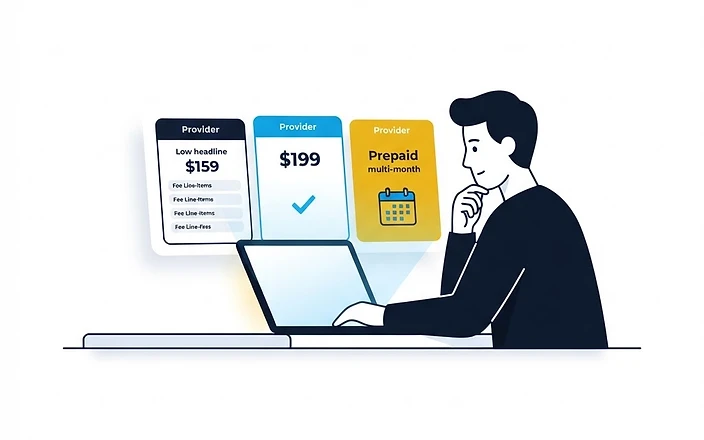
Table of Contents
- The Cheapest Number May Be Only One Part of the Cost
- Headline Price vs Total Cost
- Medication May Be Separate
- A Low Starting Price May Not Be the Ongoing Price
- Compare the Recurring Price
- The Prepaid Price Can Look Cheaper Too
- Membership Fees Can Change the Comparison
- Provider A
- Provider B
- Follow-Up May Have Financial Value Too
- Look at the Cost of Additional Visits
- Labs May or May Not Be Included
- Shipping and Supplies Can Matter
- Insurance Can Reverse the Comparison
- Compare the Same Time Period
- An Illustrative Three-Month Comparison
- Provider A
- Provider B
- Provider C
- Calculate Your "All-In" Monthly Cost
- Use an Apples-to-Apples Comparison
- Cheap and Expensive Depend on What You Need
- Low Price Should Not Replace Basic Safety Checks
- Seven Questions to Ask Before Choosing the Lowest Price
- 1. Is medication included?
- 2. Is this an introductory price?
- 3. What is the recurring monthly cost?
- 4. Are provider visits and follow-up included?
- 5. Are labs, shipping, or supplies extra?
- 6. Is the price truly month-to-month?
- 7. What will I pay over three or six months?
- The Bottom Line
- Compare Participating Provider Options
When comparing GLP-1 programs, it is natural to notice the lowest price first.
But the smallest advertised number does not always represent the smallest total cost.
One provider may advertise a low membership price while medication is charged separately.
Another may display a higher monthly amount that includes more services.
A third may show a low monthly equivalent but require several months of payment upfront.
So before deciding that one GLP-1 program is "cheaper," ask a more useful question:
What will I actually pay for the complete program over the period I expect to use it?
That is the difference between comparing headline prices and comparing real costs.
Educational information only. GoLean Horizon does not provide medical advice, prescribe medication, or determine treatment eligibility. A licensed healthcare provider determines whether treatment is medically appropriate.
The Cheapest Number May Be Only One Part of the Cost
Imagine seeing two offers:
Provider A: $99/month
Provider B: $199/month
At first glance, Provider A appears less expensive.
But suppose Provider A's $99 covers only the telehealth membership, while medication is purchased separately.
Provider B's higher displayed price might include more services.
You cannot determine which costs less until you know what each price actually includes.
That is why the first question should be:
"Is this the total cost or only one component?"
For a detailed breakdown, see:
What Does a GLP-1 Price Actually Include?
Headline Price vs Total Cost
A headline price is the number used to attract attention.
Your total cost may include some combination of:
- medication
- membership fees
- provider evaluation
- follow-up visits
- refill management
- laboratory testing
- shipping
- supplies
- insurance-related costs
- additional consultations
Not every program charges for all of these separately.
Some providers bundle several services together.
Others separate them.
That is why comparing only the advertised monthly number can produce an apples-to-oranges comparison.
Medication May Be Separate
One of the most important things to verify is whether medication is included.
A telehealth fee is not necessarily a medication price.
Current LillyDirect information, for example, states that rates shown for independent telehealth providers do not include medication costs.
That means a provider could appear inexpensive when you look only at the telehealth fee, even though the medication cost still has to be added separately.
Always ask:
Is medication included in this amount?
If not:
What should I expect to pay for the prescribed medication separately?
A Low Starting Price May Not Be the Ongoing Price
Another way a program can appear less expensive is through introductory pricing.
An offer might apply only to:
- the first month
- the first two fills
- new customers
- a limited promotion
- certain doses
The price can then change.
Current NovoCare pricing provides a real-world example: certain eligible new Wegovy patients currently receive a limited price for the first two monthly fills, followed by a different ongoing offer price.
That does not make the introductory offer invalid.
It simply means the introductory number should not be used by itself to estimate longer-term cost.
For more detail, read:
Why a $99 GLP-1 Offer May Not Stay $99
Compare the Recurring Price
If you expect to use a program beyond the first month, the recurring price becomes important.
Ask:
What is the normal ongoing monthly cost?
Then determine whether that recurring amount includes:
- medication
- membership
- provider visits
- follow-up
- refill support
- shipping
- other required services
A low introduction followed by a much higher recurring charge may create a very different total than the advertisement suggests.
The Prepaid Price Can Look Cheaper Too
Some programs reduce the effective monthly rate when several months are purchased at once.
For example:
Month-to-month: $229
versus
Six-month plan: $179/month equivalent
The second number looks substantially lower.
But if six months must be paid in advance:
$179 × 6 = $1,074 due upfront
The effective monthly cost may indeed be lower.
But the financial commitment is larger.
Before choosing a prepaid option, ask:
- How much is due today?
- How many months am I buying?
- Can I cancel?
- Are unused months refundable?
- Does the plan automatically renew?
A lower monthly equivalent and a lower upfront cost are not the same thing.
Recurring billing and cancellation rules can also change the real cost of a program:
GLP-1 Subscription Traps: What to Check Before Signing Up
For a deeper explanation, see:
The 3-Price Problem: Intro Price vs Recurring Price vs Prepaid Monthly Equivalent
Membership Fees Can Change the Comparison
Some GLP-1 telehealth services use membership pricing.
A membership might include:
- provider access
- messaging
- follow-up
- refill assistance
- educational tools
- care coordination
But medication may still cost extra.
Suppose:
Provider A
Membership:
$79
Medication:
$350
Estimated combined monthly cost:
$429
Provider B
Bundled program:
$399
If you looked only at $79 versus $399, Provider A would appear dramatically less expensive.
Once the medication is included, the comparison changes.
These numbers are illustrative, but they show why each program must be broken into the same cost categories.
Follow-Up May Have Financial Value Too
Price comparisons should also consider what happens after signup.
Ask whether the program includes:
- routine follow-up
- questions between visits
- refill assistance
- provider messaging
- help when treatment plans change
Some people may prefer a lower-cost structure with fewer bundled services.
Others may value more ongoing support.
Neither preference is automatically better.
The key is making sure the price reflects what you actually want and expect from the program.
Look at the Cost of Additional Visits
A low monthly membership may look attractive until you discover that additional provider visits have separate charges.
Ask:
Is follow-up included?
How many visits are included?
What does an additional visit cost?
Is messaging included?
Are refill-related visits extra?
A program that looks inexpensive at signup may become more expensive if the services you expect to use are billed individually.
Labs May or May Not Be Included
Laboratory testing is not required in exactly the same way for every person or every clinical situation.
A licensed provider determines whether testing is appropriate.
If testing is requested, ask whether the cost is:
- included in the program
- billed separately
- submitted to insurance
- paid directly to a laboratory
A price described as "all-inclusive" should be checked carefully so you know exactly what "all" means.
Shipping and Supplies Can Matter
Some programs include shipping.
Others may have separate charges or different fulfillment arrangements.
Depending on the medication and how it is dispensed, supplies may also be relevant.
Current manufacturer pricing illustrates why small details matter. LillyDirect's current Zepbound self-pay information, for example, notes that certain presentations may require separate needle or needle-and-syringe purchases.
So even when comparing medication prices, read the terms carefully.
Insurance Can Reverse the Comparison
Explore My Options
Compare provider options based on factors such as cost, flexibility, support, medication preferences, and overall experience.
Explore My OptionsGoLean Horizon provides educational information and provider-matching resources. A licensed healthcare provider determines whether treatment is medically appropriate.
A cash-pay price and an insurance price can be very different.
Your actual insurance cost may depend on:
- formulary coverage
- deductible
- copayment
- coinsurance
- prior authorization
- plan-specific coverage rules
HealthCare.gov encourages consumers to compare estimated total costs rather than focusing on one price component because deductibles, copayments, coinsurance, and other expenses can materially affect what people ultimately pay.
The same principle is useful here:
Do not compare one isolated number when the total financial picture is what matters.
Compare the Same Time Period
One of the best ways to make provider costs easier to understand is to compare them over the same amount of time.
Instead of comparing:
Provider A's first month
with
Provider B's normal monthly price
compare both over:
3 months
or
6 months
This creates a fairer comparison.
An Illustrative Three-Month Comparison
Imagine:
Provider A
Month 1 introductory price: $99
Months 2–3: $249 each
Three-month total:
$597
Provider B
$219 every month
Three-month total:
$657
Provider C
Six-month prepaid plan:
$179 monthly equivalent
Total required upfront:
$1,074
The lowest number shown in the advertisement is:
$99
But the actual comparison is more complicated.
Provider A costs less than Provider B over this illustrative three-month period, while Provider C has the lowest monthly equivalent but requires the largest upfront payment.
Different numbers answer different questions.
Calculate Your "All-In" Monthly Cost
A useful formula is:
Medication
Provider or membership fee
Required visits
Shipping
Other required recurring charges
=
Estimated all-in monthly cost
For prepaid plans, separately record:
Total due upfront
and
Monthly equivalent
Do not merge those two numbers.
Use an Apples-to-Apples Comparison
Before deciding which provider costs less, complete a table like this:
| Cost Category | Provider A | Provider B | Provider C |
|---|---|---|---|
| Advertised price | |||
| Introductory period | |||
| Ongoing monthly price | |||
| Medication included? | |||
| Membership fee | |||
| Initial provider visit | |||
| Follow-up included? | |||
| Labs extra? | |||
| Shipping extra? | |||
| Supplies extra? | |||
| Prepayment required? | |||
| Amount due today | |||
| Cancellation terms | |||
| Estimated 3-month total | |||
| Estimated 6-month total |
Now you are comparing the same components across each provider.
Cheap and Expensive Depend on What You Need
There is another reason the word "cheapest" can be misleading.
People value different things.
One person may prioritize:
Lowest overall cost
Another may prioritize:
Month-to-month flexibility
Someone else may care most about:
Provider support
or:
Simple online access
A program with more included support may cost more.
That does not automatically mean it is better.
A simpler program may cost less.
That does not automatically make it the better fit either.
The useful question is:
"What am I paying for, and does that structure match what matters to me?"
Low Price Should Not Replace Basic Safety Checks
Price should also not be the only consideration when prescription medication is involved.
FDA advises consumers using telehealth services for GLP-1 medications to look for licensed healthcare professionals and appropriately licensed pharmacies.
FDA also warns consumers about offers that appear unusually inexpensive when combined with other red flags, such as lack of appropriate medical screening, no licensed clinician available for questions, or unclear pharmacy information.
Compounded GLP-1 drugs are not FDA-approved and do not undergo FDA premarket review for safety, effectiveness, and quality.
So before comparing price, make sure you understand what medication and healthcare service are actually being offered.
Seven Questions to Ask Before Choosing the Lowest Price
Before signing up for the least-expensive-looking program, ask:
1. Is medication included?
If not, add the medication cost.
2. Is this an introductory price?
Find out when it changes.
3. What is the recurring monthly cost?
This may matter more than month one.
4. Are provider visits and follow-up included?
Additional visits may change the total.
5. Are labs, shipping, or supplies extra?
Include required charges in your comparison.
6. Is the price truly month-to-month?
A low monthly equivalent may require prepayment.
7. What will I pay over three or six months?
Compare the same time period across providers.
The Bottom Line
The lowest advertised GLP-1 price is not necessarily the lowest total cost.
Before deciding which program costs less, compare:
Medication
Membership fees
Provider visits
Follow-up
Labs
Shipping
Supplies
Introductory pricing
Recurring pricing
Prepayment
and
Cancellation terms
Then calculate the expected total over the same period.
The goal is not to find the smallest number on the page.
It is to understand the complete financial picture behind that number.
For a broader overview, read:
GLP-1 Costs Explained: How to Compare Provider Prices
Beyond price, comparing providers means asking the same questions of each one. Read: 7 Questions to Ask Before Choosing a GLP-1 Provider
Compare Participating Provider Options
Different people prioritize different things, including cost, flexibility, support, and simplicity.
GoLean Horizon helps you compare participating provider options based on your preferences.
Explore My Options
GoLean Horizon provides educational information and provider-matching resources. We do not provide medical advice, prescribe medication, or determine treatment eligibility. A licensed healthcare provider determines whether treatment is medically appropriate.
Frequently Asked Questions
Why is the cheapest GLP-1 program not always the lowest total cost?
The lowest advertised price may exclude medication, provider visits, follow-up, labs, shipping, or supplies. A program that looks less expensive upfront can cost more once all required components are added together. The useful comparison is the estimated total over the same time period, not the headline number alone.
What is the difference between a headline price and an all-in monthly cost?
A headline price is the number used to attract attention. It may represent only a membership fee, an introductory rate, or a monthly equivalent that requires prepayment. Your all-in monthly cost includes medication, fees, visits, shipping, and any other required recurring charges added together.
How do I compare GLP-1 providers fairly?
Break each program into the same cost categories — medication, membership, visits, follow-up, labs, shipping, supplies, and cancellation terms — then calculate the estimated total over the same period, such as three or six months. This produces an apples-to-apples comparison rather than comparing one isolated number.
Does a lower monthly equivalent always mean a cheaper program?
Not necessarily. A lower monthly equivalent often requires several months of payment upfront. The effective monthly cost may be lower, but the financial commitment is larger. A lower monthly equivalent and a lower upfront cost are not the same thing.
Should I consider safety as well as price when comparing GLP-1 programs?
Yes. FDA advises consumers using telehealth services for GLP-1 medications to look for licensed healthcare professionals and appropriately licensed pharmacies. Offers that appear unusually inexpensive combined with red flags such as lack of medical screening or unclear pharmacy information should be approached with caution. Price should not replace basic safety checks.
Explore My Options
Compare provider options based on factors such as cost, flexibility, support, medication preferences, and overall experience.
Explore My OptionsGoLean Horizon provides educational information and provider-matching resources. A licensed healthcare provider determines whether treatment is medically appropriate.
Educational information only. GoLean Horizon does not provide medical advice, prescribe medication, or determine treatment eligibility. A licensed healthcare provider determines whether treatment is medically appropriate.
Continue Learning
GLP-1 Costs Explained: How to Compare Provider Prices
GLP-1 pricing can be confusing. Learn how to compare medication costs, provider fees, memberships, labs, shipping, insurance, introductory offers, and ongoing monthly costs before choosing a provider.
Why a $99 GLP-1 Offer May Not Stay $99
A $99 GLP-1 offer may represent an introductory price, provider membership, or monthly equivalent rather than your complete ongoing cost. Learn what to check before signing up.

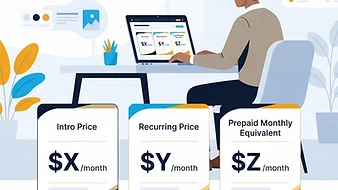
The 3-Price Problem: Intro Price vs Recurring Price vs Prepaid Monthly Equivalent
A GLP-1 program may show an introductory price, an ongoing monthly price, or a prepaid monthly equivalent. Learn how to tell them apart and compare the real financial commitment.
What Does a GLP-1 Price Actually Include?
A GLP-1 price may include medication, provider visits, membership, follow-up, shipping, or only part of the program. Learn what to check before comparing providers.