
What Does a GLP-1 Price Actually Include?
A GLP-1 price may include medication, provider visits, membership, follow-up, shipping, or only part of the program. Learn what to check before comparing providers.
Table of Contents
- Start With One Simple Question
- 1. Medication
- 2. Initial Provider Evaluation
- 3. Follow-Up Care
- 4. Membership or Platform Fee
- 5. Prescription and Refill Management
- 6. Laboratory Testing
- 7. Shipping
- 8. Supplies
- 9. Insurance Support
- 10. Self-Pay Versus Insurance Pricing
- 11. Savings Programs
- 12. Introductory Pricing
- 13. Prepaid Plans
- FDA-Approved Versus Compounded Medication
- The "What's Included?" Checklist
- Medication
- Provider Care
- Membership
- Labs
- Shipping
- Refills
- Insurance
- Commitment
- Compare the Same Things
- Don't Assume "More Included" Automatically Means Better
- The Bottom Line
- Compare Participating Provider Options
What Does a GLP-1 Price Actually Include?
You see a GLP-1 program advertised for a certain amount per month.
But what are you actually buying?
That question is more important than it may seem.
Depending on the provider, the displayed price could include medication, provider access, follow-up, shipping, or several services bundled together.
In other cases, the advertised price may cover only one part of the program.
That means two providers displaying similar monthly prices may actually be offering very different things.
Before comparing GLP-1 programs, break the price into its individual parts.
Educational information only. GoLean Horizon does not provide medical advice, prescribe medication, or determine treatment eligibility. A licensed healthcare provider determines whether treatment is medically appropriate.
Start With One Simple Question
Before comparing prices, ask:
"What exactly is included in this amount?"
Do not assume that a price displayed on a telehealth website automatically includes the prescription medication.
Some telehealth platforms charge separately for provider services and medication.
Others may bundle more services together.
For example, current telehealth information published through LillyDirect specifically notes that rates displayed for independent providers do not include medication costs.
That is why comparing the headline number alone can be misleading.
For a broader explanation of GLP-1 pricing, read:
GLP-1 Costs Explained: How to Compare Provider Prices
1. Medication
The first item to identify is the medication itself.
Ask:
Is medication included in the displayed price?
If it is not, ask what you may need to pay separately.
Do not assume that:
program price = medication price
A telehealth service may charge for access to its clinicians or platform while the prescription is filled and paid for separately through a pharmacy.
The medication cost may also depend on factors such as:
- the medication prescribed
- the dose or formulation
- insurance coverage
- self-pay arrangements
- manufacturer programs
- the dispensing pharmacy
Some manufacturer self-pay programs currently use different prices depending on the medication presentation or dose, which is another reason to confirm the specific price that applies to your situation.
2. Initial Provider Evaluation
Prescription GLP-1 treatment requires medical evaluation by an appropriately licensed healthcare provider.
Depending on the service, the initial evaluation may be:
- included in the advertised program price
- included in a membership
- billed separately
- charged per visit
Before paying, ask:
Is the initial provider review included?
Also ask whether the price covers only the first evaluation or continued access to the provider.
A low medication price and a low provider-service price are not necessarily the same offer.
3. Follow-Up Care
The initial visit is only the beginning of the experience.
People may have questions later about:
- their treatment plan
- side effects
- dosing instructions
- refills
- medication availability
- follow-up requirements
Provider support can therefore be an important part of a telehealth program.
Ask:
Are follow-up visits included in the monthly price?
Can I contact the provider between scheduled visits?
Are additional consultations charged separately?
How frequently is follow-up required?
FDA consumer guidance regarding online and compounded GLP-1 products specifically advises patients to work with licensed healthcare professionals and identifies lack of access to a licensed doctor for questions after medication is received as a telehealth warning sign.
So support is more than a convenience.
It can be an important part of responsible care.
4. Membership or Platform Fee
Some telehealth businesses operate through subscriptions or memberships.
A membership may provide services such as:
- access to a digital platform
- clinician visits
- care coordination
- messaging
- refill assistance
- educational resources
- progress tracking
But medication may still be separate.
This can create a price structure that looks like:
Monthly membership
plus
Medication
rather than one all-inclusive monthly charge.
Before enrolling, ask:
Is there a membership fee in addition to the medication cost?
And:
What services does the membership actually provide?
5. Prescription and Refill Management
Refill support is another feature that may or may not be included.
Ask how the program handles:
- refill requests
- prescription renewals
- provider review before refills
- pharmacy coordination
- dose changes
- refill delays
Some programs may bundle these services into a recurring fee.
Others may require additional appointments or charges.
A useful comparison therefore looks beyond the first prescription and considers how ongoing care works.
6. Laboratory Testing
Laboratory testing requirements are not identical for everyone.
Whether testing is appropriate depends on the individual, the medication being considered, medical history, and the clinical judgment of the licensed provider.
If laboratory testing is requested, ask:
Are labs included in the program price?
Will they be billed separately?
Can I use my insurance?
Do I have to use a particular laboratory?
What happens if additional testing is needed?
Do not assume that the phrase:
"all inclusive"
automatically includes every possible laboratory test.
Ask the provider directly.
7. Shipping
If medication or supplies are delivered to your home, determine whether shipping is included.
Ask:
Is shipping free or billed separately?
Is expedited shipping extra?
Does the medication come from a pharmacy or directly through another fulfillment arrangement?
Can I choose pharmacy pickup instead?
Some manufacturer programs currently offer both home-delivery and pharmacy-pickup pathways, illustrating why fulfillment can be a separate component of the overall experience.
8. Supplies
Depending on the prescribed treatment and how it is dispensed, a patient may need certain administration supplies.
If relevant, ask whether necessary supplies are:
- included
- provided by the pharmacy
- purchased separately
Do not assume a medication price automatically includes every item required for administration.
Your provider or pharmacist should explain what is needed for the medication prescribed to you.
9. Insurance Support
Some telehealth services may help patients navigate insurance-related requirements.
This can include assistance with:
- benefit verification
- prior authorization
- pharmacy coordination
- documentation
- understanding coverage requirements
But the level of assistance varies.
Ask:
Does the program help with insurance authorization?
Is that service included?
What happens if insurance denies coverage?
Your actual prescription cost can depend on your health plan's deductible, copayments, coinsurance, formulary, and coverage requirements.
HealthCare.gov recommends considering total costs rather than looking at one number in isolation because deductibles, copayments, coinsurance, and other out-of-pocket expenses can materially affect what a person ultimately pays.
Explore My Options
Compare provider options based on factors such as cost, flexibility, support, medication preferences, and overall experience.
Explore My OptionsGoLean Horizon provides educational information and provider-matching resources. A licensed healthcare provider determines whether treatment is medically appropriate.
10. Self-Pay Versus Insurance Pricing
A provider may offer more than one payment path.
For example:
Insurance
or
Self-pay
These can lead to very different prices.
If you pay outside insurance, ask whether that payment will count toward your insurance deductible or out-of-pocket limit.
It may not.
Current NovoCare information, for example, notes that when patients elect to self-pay outside insurance, those payments do not count toward insurance deductibles or out-of-pocket limits.
So when comparing prices, determine whether you are looking at:
- an insurance price
- a self-pay price
- a savings-program price
- a telehealth provider fee
These numbers describe different things.
11. Savings Programs
Manufacturer savings programs can reduce costs for some eligible patients.
But eligibility rules apply.
Ask:
Who qualifies?
How long does the offer last?
Is commercial insurance required?
Does the price change after a certain number of fills?
Could the program terms change?
Savings programs should therefore be treated separately from a provider's standard recurring price.
12. Introductory Pricing
A program may offer a discounted starting price.
That does not necessarily mean the same amount continues indefinitely.
Ask:
Is this the regular price or an introductory price?
When does it change?
What will the ongoing price be?
If you have already read our guide on this issue, you know why this matters:
Why a $99 GLP-1 Offer May Not Stay $99
The price that gets you through the door may not be the best number for estimating your longer-term cost.
13. Prepaid Plans
Some providers may offer a lower effective monthly price when several months are purchased upfront.
This may be presented as:
Monthly equivalent
rather than a true month-to-month payment.
Before choosing that option, determine:
- how much you must pay upfront
- how long you are committing
- whether the plan automatically renews
- whether cancellation is allowed
- whether unused months are refundable
A lower monthly equivalent may come with less flexibility.
For a side-by-side explanation of intro price, recurring price, and prepaid monthly equivalent, read:
The 3-Price Problem: Intro Price vs Recurring Price vs Prepaid Monthly Equivalent
FDA-Approved Versus Compounded Medication
Another important question is what type of medication the price refers to.
Some programs may involve an FDA-approved medication.
Others may involve compounded medication.
These are not the same regulatory category.
FDA-approved medications undergo FDA review before approval.
Compounded medications are not FDA-approved, and FDA does not review compounded drugs before marketing for safety, effectiveness, or quality.
FDA says compounded medications can serve an important medical need in certain circumstances, but patients should understand what they are receiving and obtain prescription medications through appropriate licensed healthcare professionals and pharmacies.
So when comparing pricing, ask:
What medication does this price actually refer to?
Do not compare two dollar amounts without first determining whether the products and services behind those numbers are comparable.
The "What's Included?" Checklist
Before choosing a GLP-1 program, use this checklist.
Medication
- Is medication included?
- Which medication does the price refer to?
- Can the price change by dose or formulation?
Provider Care
- Is the initial evaluation included?
- Are follow-up visits included?
- Can I message the provider?
- Are additional visits extra?
Membership
- Is there a monthly platform or membership fee?
- What services does it provide?
Labs
- Are laboratory tests included?
- Can testing be billed to insurance?
Shipping
- Is shipping included?
- Are there other fulfillment fees?
Refills
- Is refill management included?
- Are prescription renewals or follow-ups extra?
Insurance
- Does the provider accept or assist with insurance?
- Is prior-authorization assistance available?
Commitment
- Is the price month-to-month?
- Is prepayment required?
- What are the cancellation and refund terms?
Compare the Same Things
Here is a simple way to compare providers:
| What's Included? | Provider A | Provider B | Provider C |
|---|---|---|---|
| Medication | |||
| Initial provider review | |||
| Follow-up visits | |||
| Membership | |||
| Messaging/support | |||
| Refill management | |||
| Labs | |||
| Shipping | |||
| Supplies | |||
| Insurance assistance | |||
| Prepayment required | |||
| Cancellation terms | |||
| Total expected monthly cost |
This helps turn vague advertising into a more useful comparison.
For a deeper look at how included services and separate charges can change which program really costs less, read:
Cheapest Isn’t Always Cheapest: How to Compare the Real Cost of a GLP-1 Program
Don't Assume "More Included" Automatically Means Better
A program with many included services may be useful for someone who values additional support.
Another person may prefer a simpler program with fewer bundled services and a lower cost.
Different people care about different things.
For example:
Cost
Flexibility
Provider support
Follow-up
Medication options
Insurance assistance
Simplicity
That is why the question is not:
"Which provider includes the most?"
It is:
"Which program structure best matches what matters to me?"
The Bottom Line
When you see a GLP-1 price online, do not assume you are looking at the complete cost.
Find out whether it includes:
Medication
Provider evaluation
Follow-up
Membership fees
Refill management
Labs
Shipping
Supplies
Insurance support
and
ongoing services
Then determine whether the displayed amount is:
an introductory price
an ongoing price
a self-pay price
an insurance-related price
or
a prepaid monthly equivalent
Once you understand what is behind the number, comparing providers becomes much easier.
Compare Participating Provider Options
GoLean Horizon helps you compare participating GLP-1 provider options based on factors such as cost, flexibility, support, medication preferences, and overall experience.
Explore My Options
GoLean Horizon provides educational information and provider-matching resources. We do not provide medical advice, prescribe medication, or determine treatment eligibility. A licensed healthcare provider determines whether treatment is medically appropriate.
Sources & References
- 1.LillyDirect — Telehealth Options for Obesity: Lilly expressly states that the rates reported by the independent telehealth providers on the page do not include medication costs.
- 2.NovoCare — Wegovy Cost, Coverage & Savings Resources: Distinguishes self-pay from insurance, different fulfillment options, and notes that self-pay outside insurance does not count toward deductibles or out-of-pocket limits.
- 3.HealthCare.gov — Your Total Costs for Health Care: Explains that deductibles, copayments, coinsurance, and other out-of-pocket costs contribute to total healthcare costs.
- 4.FDA — FDA's Concerns with Unapproved GLP-1 Drugs Used for Weight Loss: Addresses compounded GLP-1 products, FDA approval status, licensed pharmacies, and telehealth warning signs.
- 5.FDA — Compounding and the FDA: Questions and Answers: States that compounded drugs are not FDA-approved and explains when compounding may serve a patient need.
Frequently Asked Questions
Does a GLP-1 program price always include the medication?
No. Some telehealth prices cover provider services, memberships, or consultations while medication is charged separately. Always confirm what the displayed price includes before comparing providers.
What fees can be separate from a GLP-1 medication price?
Depending on the provider, separate costs may include membership fees, provider visits, follow-up, laboratory testing, shipping, supplies, or other services.
Are follow-up visits usually included in GLP-1 pricing?
It depends on the provider. Some programs include ongoing follow-up or messaging, while others may charge separately for additional visits or services. Confirm the program's terms before enrolling.
Are GLP-1 laboratory tests included in the monthly price?
Not necessarily. Whether laboratory testing is needed depends on the individual and provider's clinical judgment, and the cost may be bundled, billed separately, or submitted to insurance.
Does paying cash for GLP-1 medication count toward my insurance deductible?
Not necessarily. When a medication is purchased outside the insurance benefit, the payment may not count toward the plan's deductible or out-of-pocket limit. Current NovoCare self-pay information specifically states this for its outside-insurance self-pay pathway.
Are compounded GLP-1 medications FDA-approved?
No. FDA states that compounded drugs are not FDA-approved and are not reviewed by FDA for safety, effectiveness, or quality before marketing.
What should I ask before comparing GLP-1 provider prices?
Ask whether medication, provider visits, follow-up, membership, labs, shipping, refill support, and other services are included, and determine whether the displayed amount is introductory, recurring, self-pay, insurance-related, or based on prepayment.
Explore My Options
Compare provider options based on factors such as cost, flexibility, support, medication preferences, and overall experience.
Explore My OptionsGoLean Horizon provides educational information and provider-matching resources. A licensed healthcare provider determines whether treatment is medically appropriate.
Educational information only. GoLean Horizon does not provide medical advice, prescribe medication, or determine treatment eligibility. A licensed healthcare provider determines whether treatment is medically appropriate.
Continue Learning

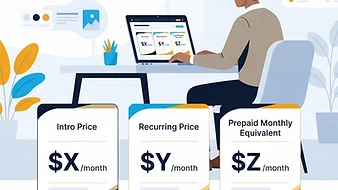
The 3-Price Problem: Intro Price vs Recurring Price vs Prepaid Monthly Equivalent
A GLP-1 program may show an introductory price, an ongoing monthly price, or a prepaid monthly equivalent. Learn how to tell them apart and compare the real financial commitment.
Why a $99 GLP-1 Offer May Not Stay $99
A $99 GLP-1 offer may represent an introductory price, provider membership, or monthly equivalent rather than your complete ongoing cost. Learn what to check before signing up.
GLP-1 Costs Explained: How to Compare Provider Prices
GLP-1 pricing can be confusing. Learn how to compare medication costs, provider fees, memberships, labs, shipping, insurance, introductory offers, and ongoing monthly costs before choosing a provider.