
Semaglutide vs Tirzepatide: What's the Difference?
Semaglutide and tirzepatide are both used in FDA-approved medications for weight management and type 2 diabetes, but they work differently. Learn about GLP-1 vs GIP/GLP-1 activity, indications, weight-loss evidence, side effects, dosing, and other differences.
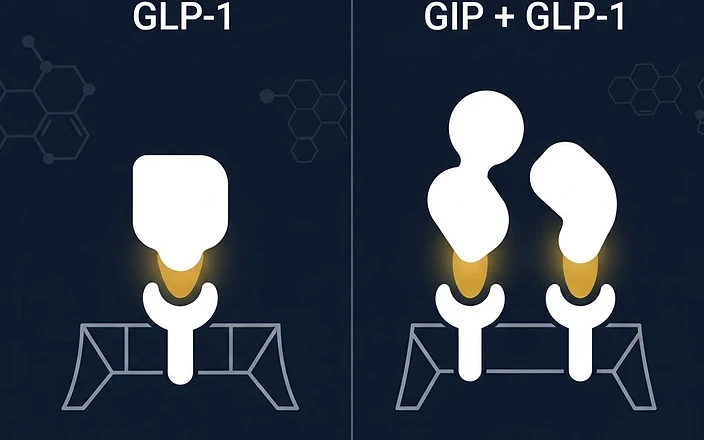
Table of Contents
- Quick Comparison: Semaglutide vs Tirzepatide
- What Is Semaglutide?
- What Is Tirzepatide?
- The Biggest Difference: One Hormone Pathway vs Two
- Semaglutide
- Tirzepatide
- Are Both Used for Weight Management?
- What Did the Head-to-Head Trial Find?
- What That Study Does — and Does Not — Tell Us
- Do They Both Reduce Appetite?
- How Are They Taken?
- Why Are the Doses So Different?
- What Side Effects Do They Have in Common?
- Are There Important Safety Warnings?
- What About Surgery or Anesthesia?
- Do Both Have Cardiovascular Indications?
- What About Obstructive Sleep Apnea?
- Is One Medication More Effective for Everyone?
- Can Someone Switch Between Them?
- Should They Be Taken Together?
- What About Compounded Semaglutide or Tirzepatide?
- Semaglutide vs Tirzepatide: Side-by-Side
- What Should You Compare Beyond Weight-Loss Numbers?
- Medical appropriateness
- Side-effect tolerance
- FDA-approved indication
- Formulation
- Insurance
- Cost
- Access
- Follow-up
- Questions to Ask a Provider
- Provider Choice and Medication Choice Are Different Decisions
- Cost Can Differ Too
- The Bottom Line
Semaglutide and tirzepatide are two medications commonly discussed in conversations about GLP-1 treatment, type 2 diabetes, and weight management.
They have similarities.
But they are not the same drug.
One of the biggest differences is how they interact with hormone receptors involved in appetite, digestion, and blood glucose regulation.
Semaglutide activates the GLP-1 receptor.
Tirzepatide activates both GIP and GLP-1 receptors.
Both are prescription medications, and whether either is appropriate depends on the individual, the specific FDA-approved product and indication, medical history, other medications, and clinical evaluation.
Educational information only. GoLean Horizon does not provide medical advice, prescribe medication, recommend one medication over another, or determine treatment eligibility. A licensed healthcare provider determines whether treatment is medically appropriate.
Quick Comparison: Semaglutide vs Tirzepatide
| Feature | Semaglutide | Tirzepatide |
|---|---|---|
| Drug class | GLP-1 receptor agonist | GIP and GLP-1 receptor agonist |
| Main hormone pathways | GLP-1 | GIP + GLP-1 |
| Prescription medication | Yes | Yes |
| FDA-approved products include | Wegovy, Ozempic, Rybelsus | Zepbound, Mounjaro |
| Weight-management product | Wegovy | Zepbound |
| Type 2 diabetes product | Ozempic / Rybelsus | Mounjaro |
| Can affect appetite | Yes | Yes |
| Can slow gastric emptying | Yes | Yes |
| GI side effects possible | Yes | Yes |
| Clinical evaluation required | Yes | Yes |
Brand names have different FDA-approved indications, formulations, and labeling.
A drug's active ingredient alone does not tell you which branded product or indication applies.
What Is Semaglutide?
Semaglutide is a GLP-1 receptor agonist.
GLP-1 stands for:
glucagon-like peptide-1
GLP-1 is a naturally occurring hormone involved in several processes, including:
- appetite regulation
- glucose-dependent insulin secretion
- glucagon regulation
- gastric emptying
By activating GLP-1 receptors, semaglutide can help reduce appetite and food intake while also affecting glucose regulation.
Different FDA-approved semaglutide products are used for different purposes.
These include products for:
- chronic weight management
- type 2 diabetes
- certain cardiovascular-risk indications
Do not assume products containing the same active ingredient are interchangeable.
Their FDA-approved indications, formulations, doses, and instructions may differ.
What Is Tirzepatide?
Tirzepatide works somewhat differently.
It activates two hormone receptors:
GIP
and
GLP-1
GIP stands for:
glucose-dependent insulinotropic polypeptide
Tirzepatide is therefore often described as a:
dual GIP and GLP-1 receptor agonist
Like GLP-1 signaling, GIP signaling is involved in metabolic processes associated with glucose regulation and energy balance.
FDA-approved tirzepatide products include:
Zepbound for certain weight-management indications and certain adults with obesity and moderate-to-severe obstructive sleep apnea.
Mounjaro for type 2 diabetes.
The specific indication depends on the branded FDA-approved product.
The Biggest Difference: One Hormone Pathway vs Two
The easiest way to remember the difference is:
Semaglutide
Targets:
GLP-1
Tirzepatide
Targets:
GIP + GLP-1
That does not mean patients should choose medication simply based on the number of receptors involved.
More receptor targets do not automatically mean that a medication is medically preferable for a particular person.
Treatment decisions depend on factors such as:
- medical history
- treatment indication
- other medications
- contraindications
- side-effect tolerance
- insurance coverage
- availability
- previous treatment
- clinician assessment
Are Both Used for Weight Management?
FDA-approved products containing both medications are available for chronic weight management in certain patients.
For semaglutide, the principal weight-management brand is:
Wegovy
For tirzepatide, it is:
Zepbound
These drugs should not be confused with every product containing the same ingredient.
For example:
Ozempic contains semaglutide
but its labeling is not identical to Wegovy's.
Similarly:
Mounjaro contains tirzepatide
but its labeling differs from Zepbound's.
This distinction matters when comparing treatment options.
What Did the Head-to-Head Trial Find?
One of the most important direct comparisons is the SURMOUNT-5 trial, published in the New England Journal of Medicine in 2025.
The study included 751 adults with obesity or overweight and an obesity-related complication who did not have type 2 diabetes.
Participants received either:
- tirzepatide at the maximum tolerated dose of 10 mg or 15 mg
or
- semaglutide at the maximum tolerated dose of 1.7 mg or 2.4 mg
once weekly for 72 weeks.
At week 72, average estimated body-weight change was:
−20.2% with tirzepatide
versus
−13.7% with semaglutide
The tirzepatide group also had a greater average reduction in waist circumference.
Gastrointestinal adverse events were the most common side effects in both groups and were generally mild to moderate.
What That Study Does — and Does Not — Tell Us
The study provides important direct comparative evidence.
But it should not be interpreted as:
"Tirzepatide is always better than semaglutide."
The trial involved a specific population:
adults with obesity without type 2 diabetes
It used particular doses.
It lasted 72 weeks.
And the trial was funded by Eli Lilly, the manufacturer of tirzepatide.
There is another important 2026 consideration.
FDA approved a new higher-dose semaglutide product, Wegovy HD 7.2 mg, in March 2026 for certain adults.
The SURMOUNT-5 comparison used semaglutide doses of 1.7 mg or 2.4 mg, not the newer 7.2-mg dose.
Therefore, the SURMOUNT-5 numbers should not be presented as a direct comparison between tirzepatide and every currently available semaglutide dose.
Clinical trial results describe groups of participants.
They do not predict exactly how much weight an individual person will lose.
Do They Both Reduce Appetite?
Both medications can influence appetite and food intake.
GLP-1 signaling affects areas involved in appetite regulation and also slows gastric emptying.
Tirzepatide adds activity at the GIP receptor.
People may experience:
- reduced hunger
- earlier fullness
- changes in portion size
- changes in food interest
But individual experiences vary considerably.
A stronger or weaker appetite effect by itself should not be used to determine which medication someone should take.
How Are They Taken?
Several formulations now exist, and the exact instructions depend on the FDA-approved product.
For the commonly discussed injectable weight-management products:
Wegovy contains semaglutide.
Zepbound contains tirzepatide.
Injectable regimens generally use gradual dose escalation rather than beginning immediately at a maintenance dose.
This is one reason patients should follow the specific prescribing instructions they receive rather than copying someone else's dose.
Different formulations and products can have substantially different dosing instructions.
Why Are the Doses So Different?
People sometimes compare milligrams directly:
"15 mg tirzepatide sounds stronger than 2.4 mg semaglutide."
That is not a valid comparison.
Milligram numbers cannot be compared across two different drugs as though they represent equivalent strength.
The molecules, receptor activity, pharmacology, formulations, and approved dosing ranges differ.
15 mg of one drug does not mean it is simply a larger version of 2.4 mg of another drug.
Dose comparison should be based on each medication's approved prescribing information, not the number printed beside "mg."
What Side Effects Do They Have in Common?
Both drugs can cause gastrointestinal side effects.
Common effects described in FDA labeling include symptoms such as:
- nausea
- diarrhea
- vomiting
- constipation
- abdominal discomfort or pain
- indigestion
- reflux-related symptoms
Side effects may occur more often during dose escalation.
Not everyone experiences the same effects.
Some people tolerate treatment well.
Explore My Options
Compare provider options based on factors such as cost, flexibility, support, medication preferences, and overall experience.
Explore My OptionsGoLean Horizon provides educational information and provider-matching resources. A licensed healthcare provider determines whether treatment is medically appropriate.
Others may require changes in treatment or may not tolerate a medication.
Are There Important Safety Warnings?
Yes.
Both Wegovy and Zepbound carry an FDA boxed warning concerning thyroid C-cell tumors based on animal studies.
It is unknown whether these medications cause medullary thyroid carcinoma in humans.
Both are contraindicated in people with:
- a personal history of medullary thyroid carcinoma
or
- a family history of medullary thyroid carcinoma
or
- Multiple Endocrine Neoplasia syndrome type 2 (MEN 2)
Their FDA labeling also contains additional warnings and precautions.
These can include concerns related to:
- severe gastrointestinal reactions
- pancreatitis
- gallbladder disease
- kidney problems related to dehydration
- hypoglycemia in certain circumstances
- hypersensitivity reactions
- delayed gastric emptying
- anesthesia or deep sedation
The complete safety profile differs somewhat by product and patient circumstances.
This is one reason medication choice should involve a licensed healthcare professional.
What About Surgery or Anesthesia?
Both semaglutide and tirzepatide can delay gastric emptying.
FDA labeling contains warnings about reports of pulmonary aspiration during general anesthesia or deep sedation in patients taking GLP-1-related medications.
Patients should tell healthcare professionals that they are taking these medications before planned surgery or procedures involving anesthesia or deep sedation.
Do not independently stop prescription medication simply because a procedure is scheduled.
The appropriate plan should be discussed with the clinicians involved.
Do Both Have Cardiovascular Indications?
Not necessarily in the same way.
FDA-approved indications are attached to specific products.
Wegovy has an FDA indication to reduce the risk of major adverse cardiovascular events — cardiovascular death, nonfatal heart attack, or nonfatal stroke — in certain adults with established cardiovascular disease and overweight or obesity.
That is a specific FDA-approved indication for Wegovy.
It should not automatically be transferred to every semaglutide product or to tirzepatide.
When comparing medications, distinguish between:
effects researchers are studying
and
indications FDA has specifically approved.
What About Obstructive Sleep Apnea?
Zepbound has an additional FDA-approved indication involving obstructive sleep apnea.
FDA approved Zepbound for treatment of moderate-to-severe obstructive sleep apnea in adults with obesity, together with reduced-calorie diet and increased physical activity.
Again, this illustrates why the question:
"Semaglutide or tirzepatide?"
can be too broad.
The appropriate product can depend on the actual medical condition being treated.
Is One Medication More Effective for Everyone?
No.
Research can tell us how groups of participants performed in clinical trials.
It cannot tell us with certainty:
- which individual will respond more strongly
- who will experience side effects
- who will tolerate dose escalation
- which drug will be covered by insurance
- which medication will remain appropriate over time
The SURMOUNT-5 trial found greater average weight reduction with tirzepatide than with semaglutide at the doses studied.
That is different from saying that every individual should receive tirzepatide.
Treatment decisions remain individualized.
Can Someone Switch Between Them?
Medication changes should be handled by a licensed healthcare professional.
Semaglutide and tirzepatide have different:
- dosing schedules
- dose-escalation steps
- prescribing information
- formulations
- clinical considerations
There is no universal self-directed conversion such as:
"I take this many milligrams of semaglutide, so I should take this many milligrams of tirzepatide."
Do not use internet conversion charts as a substitute for medical instructions.
Should They Be Taken Together?
FDA-approved Zepbound labeling states that coadministration with another tirzepatide-containing product or with a GLP-1 receptor agonist is not recommended.
Similarly, patients should follow the limitations and instructions in the labeling for their prescribed product.
Do not combine semaglutide and tirzepatide on your own.
What About Compounded Semaglutide or Tirzepatide?
This is another important distinction.
FDA-approved semaglutide and tirzepatide products have undergone FDA review for:
- safety
- effectiveness
- manufacturing quality
Compounded drugs are not FDA approved and do not undergo FDA's premarket review for safety, effectiveness, or quality.
FDA currently states that compounded GLP-1 drugs should generally be used only when a patient's medical needs cannot be met by an FDA-approved drug.
FDA also recommends obtaining a prescription from a healthcare professional and using a state-licensed pharmacy.
So when comparing prices or providers, ask:
Is this an FDA-approved product or a compounded product?
That distinction matters.
Semaglutide vs Tirzepatide: Side-by-Side
| Question | Semaglutide | Tirzepatide |
|---|---|---|
| Activates GLP-1 receptor? | Yes | Yes |
| Activates GIP receptor? | No | Yes |
| FDA-approved weight-management product? | Wegovy | Zepbound |
| FDA-approved type 2 diabetes product? | Ozempic / Rybelsus | Mounjaro |
| Weekly injectable products available? | Yes | Yes |
| Can reduce appetite? | Yes | Yes |
| GI side effects possible? | Yes | Yes |
| Dose escalation commonly used? | Yes | Yes |
| Boxed thyroid C-cell tumor warning on weight-management labeling? | Yes | Yes |
| Prescription required? | Yes | Yes |
| Requires individualized clinical evaluation? | Yes | Yes |
What Should You Compare Beyond Weight-Loss Numbers?
A medication decision should not be reduced to:
"Which drug produced the larger number in a trial?"
Other considerations may include:
Medical appropriateness
Does the medication fit the person's health history and treatment indication?
Side-effect tolerance
How does the individual respond during treatment?
FDA-approved indication
What medical condition is actually being treated?
Formulation
What formulation is available and appropriate?
Insurance
Is the medication covered?
Cost
What will the patient actually pay?
Access
Is the medication available through the provider and pharmacy?
Follow-up
How will the healthcare team monitor and support the patient?
These factors can matter as much as headline trial percentages.
Questions to Ask a Provider
If semaglutide and tirzepatide are being discussed, consider asking:
- Which medication options are medically appropriate for me?
- What FDA-approved indication are we treating?
- Why might one option be considered instead of another?
- What side effects should I know about?
- What health conditions or medications affect the decision?
- What follow-up will be required?
- Is laboratory testing needed in my situation?
- What does my insurance cover?
- What would I pay out of pocket?
- Is the medication FDA approved or compounded?
- Which pharmacy will dispense it?
- What should I do if I experience side effects?
A clinical discussion is more useful than choosing based only on an advertisement or social-media comparison.
Provider Choice and Medication Choice Are Different Decisions
Choosing a telehealth provider does not mean choosing your own prescription.
When comparing providers, you can consider:
- what medications they evaluate
- what states they serve
- their pricing structure
- insurance support
- clinician access
- follow-up
- refill process
But the licensed healthcare provider determines whether a particular medication is medically appropriate.
For help comparing provider features, read:
How to Compare GLP-1 Providers: What Matters Most?
And before choosing a program, see:
7 Questions to Ask Before Choosing a GLP-1 Provider
Cost Can Differ Too
Even if both medications are clinically possible options, what someone pays can be very different.
Cost may depend on:
- insurance coverage
- formulary
- prior authorization
- pharmacy
- self-pay pricing
- manufacturer programs
- provider fees
- medication formulation
For insurance questions, read:
Does Insurance Cover GLP-1 Medications? What to Check With Your Health Plan
The Bottom Line
Semaglutide and tirzepatide share some similarities, but they are different medications.
The key mechanistic distinction is:
Semaglutide activates GLP-1 receptors.
Tirzepatide activates both GIP and GLP-1 receptors.
Both have FDA-approved products used in weight management and type 2 diabetes, although the specific indications vary by product.
In a major 72-week head-to-head trial in adults with obesity without type 2 diabetes, tirzepatide produced greater average weight reduction than semaglutide at the doses studied.
But that result does not establish which medication is appropriate for any particular person.
It also did not test the newer 7.2-mg Wegovy HD dose approved in 2026.
Medication selection should consider the full clinical picture — not just a headline weight-loss percentage.
A licensed healthcare provider determines which treatment, if any, is appropriate.
Sources & References
- 1.https://www.accessdata.fda.gov/drugsatfda_docs/label/2024/215256s008lbl.pdf — FDA, Wegovy (semaglutide) Prescribing Information
- 2.https://www.accessdata.fda.gov/drugsatfda_docs/label/2024/217806s007lbl.pdf — FDA, Zepbound (tirzepatide) Prescribing Information
- 3.https://www.fda.gov/news-events/press-announcements/fda-approves-new-higher-dose-wegovy — FDA, Wegovy HD 7.2 mg Approval, March 19, 2026
- 4.https://www.nejm.org/doi/full/10.1056/NEJMoa2503825 — Aronne LJ et al., Tirzepatide as Compared with Semaglutide for the Treatment of Obesity, New England Journal of Medicine, 2025
- 5.https://www.fda.gov/news-events/press-announcements/fda-approves-first-treatment-reduce-serious-cardiovascular-risk-adults-obesity-or-overweight — FDA, First Treatment to Reduce Serious Cardiovascular Risk in Adults With Obesity or Overweight
- 6.https://www.fda.gov/news-events/press-announcements/fda-approves-first-drug-treatment-obstructive-sleep-apnea — FDA, Zepbound Approval for Obstructive Sleep Apnea
- 7.https://www.fda.gov/consumers/consumer-updates/fda-warns-consumers-against-using-unapproved-glp-1-drugs-weight-loss — FDA, Concerns With Unapproved GLP-1 Drugs Used for Weight Loss
Frequently Asked Questions
What is the main difference between semaglutide and tirzepatide?
Semaglutide activates the GLP-1 receptor. Tirzepatide activates both GIP and GLP-1 receptors. They are different drugs with different FDA-approved products, doses, indications, and prescribing information.
Which caused more weight loss in the head-to-head trial?
In SURMOUNT-5, adults with obesity without type 2 diabetes receiving maximum tolerated tirzepatide doses had an estimated average weight reduction of 20.2% at 72 weeks versus 13.7% with semaglutide. The result applies to the population and doses studied and does not determine which medication is appropriate for an individual.
Did SURMOUNT-5 compare tirzepatide with the newest high-dose Wegovy?
No. SURMOUNT-5 used semaglutide 1.7 mg or 2.4 mg. FDA subsequently approved Wegovy HD 7.2 mg in March 2026 for certain adults, so SURMOUNT-5 was not a direct comparison against that newer dose.
Are Wegovy and Ozempic the same thing?
They contain the same active ingredient, semaglutide, but they are different FDA-approved products with different indications and prescribing information.
Are Zepbound and Mounjaro the same thing?
Both contain tirzepatide, but they are branded products with different FDA-approved indications. Zepbound includes weight-management indications, while Mounjaro is approved for glycemic control in adults with type 2 diabetes.
Do semaglutide and tirzepatide have similar side effects?
Both can cause gastrointestinal effects such as nausea, diarrhea, vomiting, constipation, and abdominal symptoms. Their complete safety profiles and labeling are not identical.
Can semaglutide and tirzepatide be taken together?
Patients should not combine them on their own. Zepbound labeling states that coadministration with other tirzepatide-containing products or GLP-1 receptor agonists is not recommended.
Explore My Options
Compare provider options based on factors such as cost, flexibility, support, medication preferences, and overall experience.
Explore My OptionsGoLean Horizon provides educational information and provider-matching resources. A licensed healthcare provider determines whether treatment is medically appropriate.
Educational information only. GoLean Horizon does not provide medical advice, prescribe medication, or determine treatment eligibility. A licensed healthcare provider determines whether treatment is medically appropriate.
Continue Learning


Does Insurance Cover GLP-1 Medications? What to Check With Your Health Plan
GLP-1 insurance coverage varies by medication, health plan, medical indication, and coverage rules. Learn how to check your formulary, prior authorization, deductible, copay, pharmacy network, Medicare GLP-1 Bridge, and appeal options.


What Happens After You Sign Up for a GLP-1 Telehealth Program?
After signing up for a GLP-1 telehealth program, you may complete a health intake, undergo licensed provider review, answer follow-up questions, receive next-step instructions, and learn how prescriptions, pharmacy fulfillment, follow-up, and refills work.


7 Questions to Ask Before Choosing a GLP-1 Provider
Before choosing a GLP-1 telehealth provider, ask what the price includes, who reviews your information, whether medication and follow-up are included, how refills work, and what requirements apply.


How to Compare GLP-1 Providers: What Matters Most?
Different people prioritize different things when comparing GLP-1 providers. Learn how to compare cost, flexibility, support, medication options, insurance help, simplicity, and the overall care experience.